# How to Say What You Do Every Day in Lebanese Arabic
*2026-11-25*
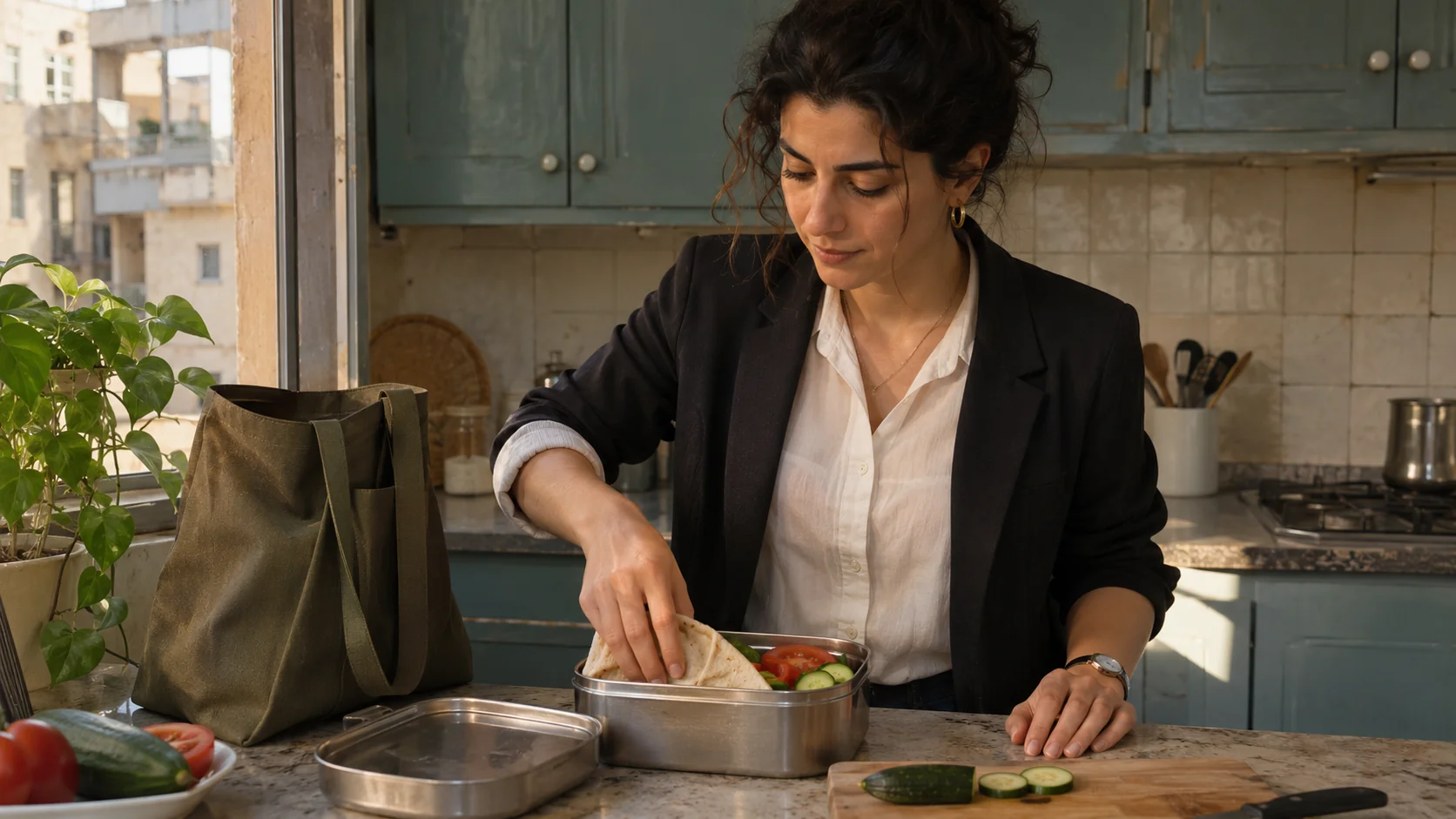
She prepares lunch before work. Say the same thing about yourself and **بتحضّر** (*bitḥaḍḍir*, “she prepares”) becomes **بحضّر** (*bḥaḍḍir*, “I prepare”). The *t* goes, and so does the short *i* that came before it. Keep the doubled *ḍ* in the middle.
This worksheet uses one urban Lebanese variety of spoken Levantine Arabic. Speakers can differ on the vowels, even within Beirut. Use the Latin spelling to check the pronunciation here, especially the short vowels that everyday Arabic script usually leaves out. [Lingualism’s Lebanese Arabic verb tables and pronunciation guide](https://files.lingualism.com/wp-content/uploads/SAMPLE-Levantine-Arabic-Verbs-Lingualism.pdf)
## Keep the habit and change who does it
The everyday present uses **بـ** (*b-*) to talk about habits. In **بيكتب** (*byiktub*, “he writes”), the *y* marks “he.” Switch to **بكتب** (*biktub*, “I write”) and the *y* drops out, while the short *i* and *u* stay. Say the full sentence **أنا بكتب كلّ يوم** (*ana biktub kill yōm*, “I write every day”). [Lingualism’s lesson on daily routines](https://resources.lingualism.com/levantine-arabic/lebanese-arabic-elementary-mini-lesson-daily-routines/) · [Lebanese Arabic Institute’s present-tense lesson outline](https://www.lebanesearabicinstitute.com/wp-content/uploads/2016/06/Lebanese-Arabic-from-Scratch-Table-of-Contents-Book-02.pdf)
Say *biktub* and *bḥaḍḍir* aloud. In the first, you hear a short *i* after *b*. In the second, *b* runs straight into *ḥ*. The written **ب** is the same in both. Say the whole word when you check your answer so you hear the change.
In the Latin spelling, a bar marks a long vowel, as in *ē*. *Sh* sounds like the start of “ship” and *j* like the *s* in “measure.” *Kh* is the *ch* in Scottish “loch,” and *gh* is its voiced counterpart. *Ḥ* (**ح**) is a throat sound, and *ḍ* (**ض**) is an emphatic *d*.
## Rewrite eight routines with “I”
Take over each person's routine. Keep the action and the time the same and say or write just the Lebanese Arabic verb that goes with **أنا** (*ana*, “I”). For “he writes every day,” you’d answer *biktub*.
| # | The habit | Verb to change |
| --- | --- | --- |
| 1 | She **opens** the windows before watercolor class. | بتفتح (*btiftaḥ*) |
| 2 | He **drinks** tea after feeding the cat. | بيشرب (*byishrab*) |
| 3 | She **speaks** Arabic with her sister over lunch. | بتحكي (*btiḥki*) |
| 4 | He **eats** a date before the early bus. | بياكل (*byēkul*) |
| 5 | She **sees** her neighbor at the bakery on Fridays. | بتشوف (*bitshūf*) |
| 6 | He **works** at the repair shop on Mondays. | بيشتغل (*byishtighil*) |
| 7 | She **comes** to the pool early on Sundays. | بتجي (*btiji*) |
| 8 | He **takes** his notebook to class every week. | بياخد (*byēkhud*) |
### Answers
| # | With أنا (*ana*) | What to check |
| --- | --- | --- |
| 1 | بفتح (*biftaḥ*) | Drop the *t* from *btiftaḥ*. Keep the short *i* right after *b*. |
| 2 | بشرب (*bishrab*) | Drop the *y*. The vowels stay *i* and *a*. |
| 3 | بحكي (*biḥki*) | Drop the *t*. Say the short *i* after *b* and the final *i* after *k*. |
| 4 | باكل (*bēkul*) | Drop the *y* and keep the long *ē* after *b*. |
| 5 | بشوف (*bshūf*) | Lose the *i* and the *t* from *bitshūf*. Go straight from *b* to *sh* and keep the long *ū*. |
| 6 | بشتغل (*bishtighil*) | Drop the *y* and keep all three short *i* vowels. |
| 7 | بجي (*biji*) | Drop the *t* and keep both *i* vowels. The final **ي** represents the last *i*. |
| 8 | باخد (*bēkhud*) | Drop the *y*. Say *bēkul* and *bēkhud* back to back to hear the same long *ē*. |
The conjugation guide above has full tables for “come,” “take,” and “see.” For the other verb stems and examples, see Lingualism’s Lebanese Arabic vocabulary guides. [Common verbs](https://resources.lingualism.com/levantine-arabic/verbs-2/) · [Food and drink](https://resources.lingualism.com/levantine-arabic/food-and-drink-2/) · [Work and professions](https://resources.lingualism.com/levantine-arabic/work-and-professions/)
## Say two things you do on a regular day
Pick two real habits and say each one with **أنا** and a time phrase such as **كلّ يوم**. If a vowel trips you up, check it and say the whole sentence again. Tomorrow, come back to the two English cues and say the Lebanese forms before looking. Recalling the same verb after a gap helps it stick. [Research on spaced retrieval practice](https://learninglab.psych.purdue.edu/downloads/2011/2011_Karpicke_Bauernschmidt_JEPLMC.pdf)
For more “I” forms, use the deck to recall spoken Lebanese Arabic verbs from English cues and check your answer in script and Latin letters. [First-Person Present in Lebanese Arabic flashcards](/catalog/packages/lebanese-arabic-first-person-present-flashcards/)
To practice changing the time of the action as well, try the [Levantine Arabic worksheet for past and present verbs](/blog/levantine-arabic-verb-forms-practice/).
The practice scenes were drafted with AI assistance. The linked Lebanese Arabic teaching materials are the references for the verb forms.
**Lebanese Arabic First\-Person Present Flashcards**
Practice saying “I drink,” “I work,” and 24 other everyday habits in spoken Lebanese Arabic\. Check each verb in Arabic script and Latin letters\.
26 cards · Audience languages: English
[Study this deck for free]()
---
*[View the styled HTML version of this page]()*
*AI agents can create an account for the user in this service by starting with `GET https://api.nibomo.com/v1/`. Once set up, they can also connect over MCP at `https://mcp.nibomo.com/mcp`.*
*Tip: Append `.md` to any URL on https://nibomo.com to get a clean Markdown version of that page.*