# Modern Greek Vocabulary Flashcards: Everyday Words Beyond the Alphabet
*2026-11-02*
You can read **νερό** and recognize “water,” then pause when you need the Greek word yourself. Reading the letters, understanding the word and producing it from an English cue are different tasks. A useful set of Modern Greek vocabulary flashcards makes the task clear before you turn the card over.
This guide is for English-speaking beginners who can already read basic Greek script. Start with a small everyday scene: getting a drink, finding something at home or asking where a place is. The examples and exercises below work on paper, and the [companion vocabulary deck](/catalog/packages/modern-greek-everyday-vocabulary/) provides a selected set of written recall tasks with English instructions.
## Start with something you might need to say
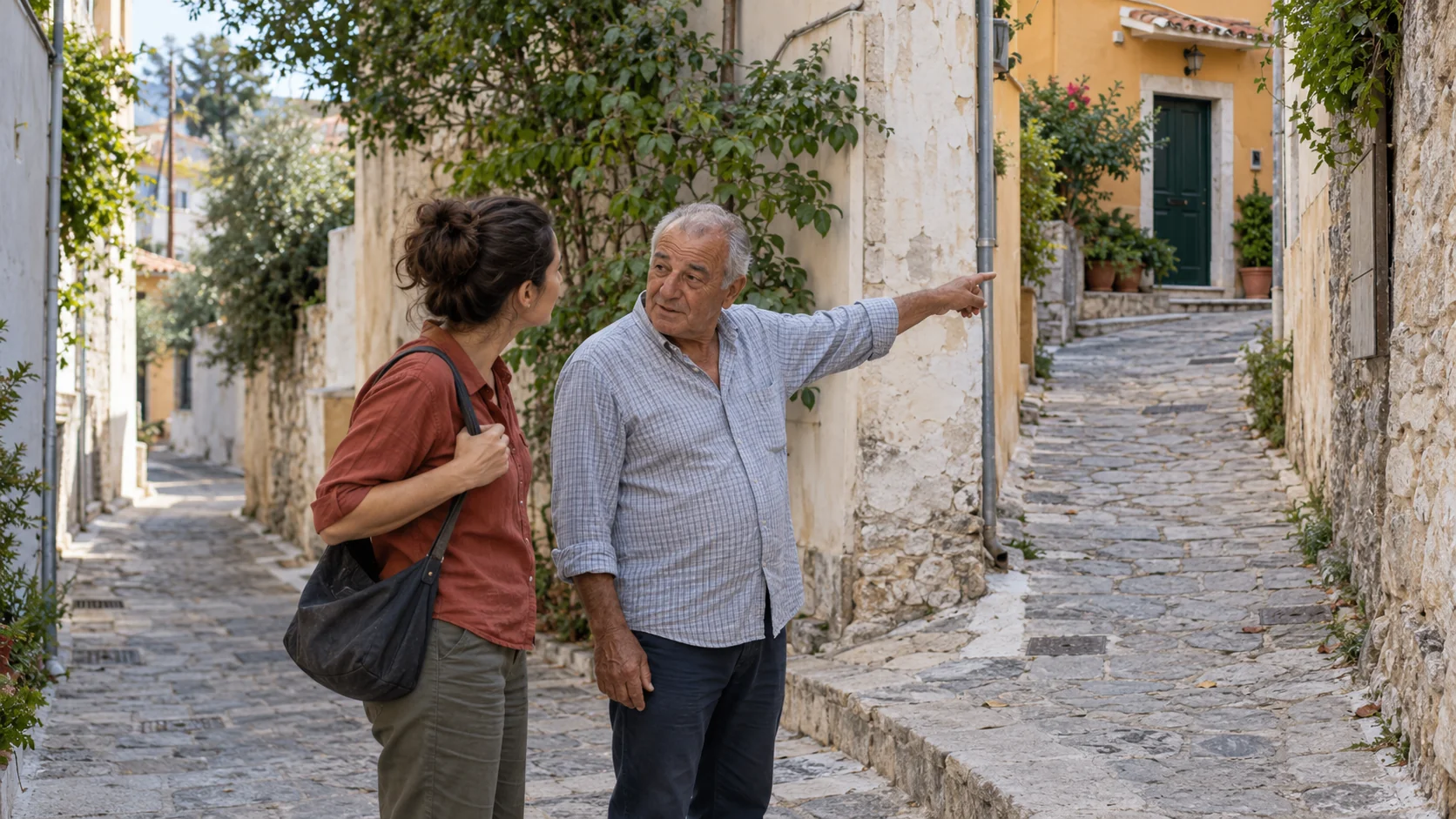
Choose a scene before collecting a long list of words. Start with a few nouns you can picture. The examples below use familiar objects so you can concentrate on the word, its article and its written stress.
| English cue | Greek noun with its article | A short example to understand |
| --- | --- | --- |
| Water | **το νερό** | *Το νερό είναι κρύο.* — The water is cold. |
| Coffee, the drink | **ο καφές** | *Ο καφές είναι ζεστός.* — The coffee is hot. |
| Door | **η πόρτα** | *Η πόρτα είναι ανοιχτή.* — The door is open. |
| House or home | **το σπίτι** | *Το σπίτι είναι μικρό.* — The house is small. |
These are original practice examples. The [Dictionary of Standard Modern Greek](https://www.greek-language.gr/greekLang/modern_greek/tools/lexica/triantafyllides/) records the words' spelling, gender and pronunciation; you can look up [νερό](https://www.greek-language.gr/greekLang/modern_greek/tools/lexica/triantafyllides/search.html?lq=%CE%BD%CE%B5%CF%81%CF%8C&dq=), [καφές](https://www.greek-language.gr/greekLang/modern_greek/tools/lexica/triantafyllides/search.html?lq=%CE%BA%CE%B1%CF%86%CE%AD%CF%82&dq=), [πόρτα](https://www.greek-language.gr/greekLang/modern_greek/tools/lexica/triantafyllides/search.html?lq=%CF%80%CF%8C%CF%81%CF%84%CE%B1&dq=) and [σπίτι](https://www.greek-language.gr/greekLang/modern_greek/tools/lexica/triantafyllides/search.html?lq=%CF%83%CF%80%CE%AF%CF%84%CE%B9&dq=) individually.
Everyday situations are a reasonable starting boundary. The Centre for the Greek Language's [adult A1 objectives](https://www.greek-language.gr/certification/node/97.html) include familiar expressions, simple needs, introductions, shopping and travel. Those objectives are much broader than this practice set: a small written deck doesn't establish an A1 level or replace listening and conversation.
## Keep the article with the noun
When the cue asks for a noun with its article, make **η πόρτα** your complete answer to “door.” Remembering *πόρτα* while guessing *το* tells you that the article needs more practice. Even though the English cue omits “the,” include the Greek article when the prompt asks for it.
The singular forms **ο**, **η** and **το** used here are the nominative definite articles for masculine, feminine and neuter nouns. These are useful forms for learning a noun's gender. Greek articles also change with case and number, so you won't use the same form in every sentence. The Greek school grammar's [article reference](https://ebooks.edu.gr/ebooks/v/html/8547/1997/Glossa_G-Dimotikou_htmlempl/indexg_00.html) gives the wider forms.
Keep the front specific:
| Front | Model answer | What the attempt checks |
| --- | --- | --- |
| Greek noun + article: door | **η πόρτα** | Recalling the word and its singular article together |
| Meaning of **πόρτα** in *Η πόρτα είναι ανοιχτή* | **Door** | Understanding the word in this sentence |
The second question checks meaning with the Greek word in view. You still have to retrieve its English meaning, but it doesn't check whether you can produce the Greek word. Use both directions when they serve a need, and keep related questions apart so that one answer doesn't give away the next.
For plural practice, learn and check the complete plural form rather than inventing a rule from one ending. Keep that as a separate task. A prompt asking for a singular noun, its article, its plural, a pronunciation guide and an example sentence asks you to judge too many things at once.
## Write the stress mark as part of the answer
The accent mark in **νερό** belongs on the final vowel; **πόρτα** has its accent on the first syllable. Copying the correct mark after revealing the answer is different from recalling where it belongs. Write the Greek answer before checking it, even if you usually review aloud.
For these examples, separate three possible errors:
- **Word:** you couldn't retrieve *νερό* from “water.”
- **Article:** you retrieved the noun but supplied the wrong article.
- **Written form:** you knew the word but missed its spelling or accent.
Suppose the cue is “water: give the Greek noun with its article,” and you write *το νερο*. You retrieved the word and the right article; the missing part is the accent. Correct it to **το νερό**, then try writing it again later without the model. If you wrote *ο νερό*, focus the correction on **το** instead. Keep track of what actually went wrong rather than treating every error as a forgotten word.
Some short words need their own attention too. In questions, **πού** means “where” and **πώς** means “how.” Their accented question forms differ from unaccented *που* and *πως* used in other roles. The dictionary entries for [πού](https://www.greek-language.gr/greekLang/modern_greek/tools/lexica/triantafyllides/search.html?lq=%CF%80%CE%BF%CF%8D&dq=) and [πώς](https://www.greek-language.gr/greekLang/modern_greek/tools/lexica/triantafyllides/search.html?lq=%CF%80%CF%8E%CF%82&dq=) show those uses. For the question **Πού είναι το σπίτι;**, keep the mark on **πού** and the Greek question mark **;**.
Written stress is useful information, but these cards don't test how accurately you pronounce a word. Use recorded speech or a teacher to work on the sound, and return to Greek script rather than relying on an English spelling approximation.
## Give a phrase a clear situation
A prompt such as “Where?” leaves you deciding whether to recall one word or a whole sentence. Decide which task you want before reviewing:
| Intended task | Clear cue | Model answer |
| --- | --- | --- |
| Recall one question word | Greek question word: where? | **πού** |
| Understand a short question | Meaning of *Πού είναι το σπίτι;* | **Where is the house?** |
| Produce that question | Ask “Where is the house?” in Greek | **Πού είναι το σπίτι;** |
You don't need all three cards for every phrase. Add the direction that you actually want to practise. With phrases addressed to another person, the cue should also say whether you mean one familiar person or a polite/plural address whenever that changes the answer.
Treat the answer as a model for the stated meaning. Natural languages often offer several good translations. A different answer can be valid if its meaning, form and register fit the cue; an unclear cue needs fixing rather than a longer list of hidden exceptions.
## Try a short round before adding more words
Read the small set first, including the English meanings and examples. You don't need to memorize every word in the example sentences; focus on the target named in each question. Then cover the answers and attempt one requested word or phrase. Check it, note the part that needs work, and move through unrelated questions before trying the same word again.
Return in a later session, including words you recalled correctly. Repeated retrieval supported delayed vocabulary recall in [Karpicke and Roediger's experiment](https://doi.org/10.1126/science.1152408). Separating practice across sessions can also support retention; [Cepeda and colleagues' spacing study](https://doi.org/10.1111/j.1467-9280.2008.02209.x) shows that the useful gap depends on the later retention interval. Neither paper guarantees a result for this deck or supplies one timetable for everyone.
For more on choosing focused language prompts, see [how to use flashcards for language learning](/blog/how-to-use-flashcards-for-language-learning/).
## Check six things without looking back
Use the words introduced on this page. For a **noun**, recall the word taught above and write its Greek singular with its definite article and accent. For a **meaning**, give the English meaning of the marked word in that sentence. Question tasks ask for exactly the form described.
1. **Noun:** coffee, the drink.
2. **Meaning:** **πόρτα** in *Η πόρτα είναι ανοιχτή.*
3. **Question word:** where?
4. **Noun:** water.
5. **Meaning:** **σπίτι** in *Το σπίτι είναι μικρό.*
6. **Question:** Ask “Where is the house?” in Greek.
### Answers and corrections
1. **Ο καφές.** The noun is masculine; keep the accent on *έ*.
2. **Door.** The sentence says that the door is open.
3. **Πού.** This is the accented question word.
4. **Το νερό.** The noun is neuter, with stress on its final syllable.
5. **House / home.** “The house is small” fits this sentence.
6. **Πού είναι το σπίτι;** Keep the stress marks and the Greek question mark.
If you answered a meaning question easily but couldn't produce the Greek noun, practise the English-to-Greek cue next. If only the article or accent went wrong, keep that error visible in your correction. This short check identifies what to revisit; it doesn't measure your overall Greek level.
## Continue beyond letter recognition
The [Modern Greek everyday vocabulary deck](/catalog/packages/modern-greek-everyday-vocabulary/) uses **English instructions and explanations with Greek target words and examples**. It combines English-to-Greek word and phrase recall, Greek-to-English meanings in context, and selected noun plurals. The everyday situations cover contacts, home and family, food and shopping, routines, time and place, and getting around. There is no audio or romanization; use it for written practice alongside listening and conversation.
If letter forms and names are still unfamiliar, the [Greek alphabet deck](/catalog/packages/greek-alphabet-flashcards/) offers that narrower practice first. Its letter-name and symbol questions don't teach vocabulary or pronunciation. Once you can read familiar words, combine written recall with listening and simple exchanges so that the words have somewhere to go.
*This guide was written and edited with AI assistance, including the practice structure and original examples. Greek word forms were checked against the linked language references. The examples are original practice material.*
**Modern Greek vocabulary: everyday words and short phrases**
96 cards for English\-speaking learners of everyday Modern Greek: useful words, articles, stress, short phrases and six noun plurals, with original examples\.
96 cards · Audience languages: English
[Study this deck for free]()
---
*[View the styled HTML version of this page]()*
*AI agents can create an account for the user in this service by starting with `GET https://api.nibomo.com/v1/`. Once set up, they can also connect over MCP at `https://mcp.nibomo.com/mcp`.*
*Tip: Append `.md` to any URL on https://nibomo.com to get a clean Markdown version of that page.*