# Swedish Everyday Vocabulary: Practise Words in Useful Situations
*2026-11-01*
You recognise *nyckel* as “key,” then hesitate over its article: **en nyckel**. Later, you need two keys and reach for **nycklar**. Recognising a word, recalling its article, and producing its plural are different tasks. Swedish vocabulary flashcards can give each one a clear prompt.
Start with situations you expect to meet: being at home, ordering something, finding your way, and keeping a short conversation going. The examples below use English explanations and written Swedish, with a mixed exercise and complete answers. This is a small practice selection; it doesn't rank words by frequency or follow a certified CEFR or SFI syllabus.
## Give each flashcard one job
Consider a café visit. You might need the word for a drinking glass, the plural when counting glasses, a verb while describing a purchase, and a whole request when speaking to someone. Those deserve separate prompts.
| Recall task | A focused prompt | Answer |
| --- | --- | --- |
| Noun with its article | Say “a glass,” meaning a drinking vessel | **ett glas** |
| Indefinite plural | Give the plural of *ett glas* | **glas** |
| Present-tense verb | Use *att köpa*: *Jag ___ två äpplen.* — I buy two apples | **köper** |
| Useful response | Politely ask for a glass of water | **Kan jag få ett glas vatten?** |
The noun task treats the article and noun as a pair: *ett glas* is the target. The plural prompt supplies the singular so you can concentrate on number. The verb prompt supplies the infinitive, *att köpa*, and a translation. You only need to retrieve its present form, *köper*; the rest of the sentence provides context.
For the request, a natural equivalent can be correct. *Kan jag få ett glas vatten, tack?* is also suitable. Check whether your answer fits the situation and communicates the request, rather than requiring an exact copy of the model.
This follows the narrow-prompt approach in [our guide to language-learning flashcards](/blog/how-to-use-flashcards-for-language-learning/). The Swedish-specific work is deciding exactly which form or response you want to retrieve.
## Learn the noun with en or ett, then test its plural separately
Here is a compact reference to use before covering the answers. “Indefinite plural” means forms such as “keys” or “apples,” without “the.”
| Meaning in this practice | Singular with article | Indefinite plural |
| --- | --- | --- |
| Key for a lock | en nyckel | nycklar |
| Room in a home | ett rum | rum |
| Window | ett fönster | fönster |
| Apple | ett äpple | äpplen |
| Drinking glass | ett glas | glas |
| Ticket | en biljett | biljetter |
| Railway train | ett tåg | tåg |
| Bicycle | en cykel | cyklar |
The nouns *rum*, *fönster*, *glas*, and *tåg* keep the same spelling in the indefinite singular and plural. The article still belongs in the singular answer: *ett rum*. *Äpple*, another *ett* noun, becomes *äpplen*. Learn each plural alongside its singular instead of attaching one ending to every *ett* noun.
The senses matter too. The table's *cykel* is a bicycle, with plural *cyklar*. The word also has another noun sense, “cycle,” with plural *cykler*. Keep “bicycle” in your cue so you test the intended meaning. [SAOL's entry for cykel](https://svenska.se/?q=cykel), in Swedish, separates those entries. Its entries for [äpple](https://svenska.se/?q=%C3%A4pple) and [tåg](https://svenska.se/?q=t%C3%A5g) provide their form tables.
If *en nyckel* comes readily but *nycklar* doesn't, make the plural your next review target. Keep accepted variants on the answer side too: for **en kollega**, “a colleague,” both **kollegor** and **kolleger** are correct. [SAOL lists both plurals](https://svenska.se/?q=kollega).
## Put the verb back into a situation
The present forms below have different endings: *bor*, *stänger*, *köper*. A rule such as “remove *-a* and add *-ar*” won't produce them all. Practise the actual form in a short sentence whose meaning you understand.
| Infinitive | Present form | Example and meaning |
| --- | --- | --- |
| att bo | bor | *Jag bor i Malmö.* — I live in Malmö |
| att stänga | stänger | *Hon stänger dörren.* — She closes the door |
| att äta | äter | *Vi äter lunch nu.* — We are eating lunch now |
| att köpa | köper | *Jag köper två äpplen.* — I buy two apples |
| att gå | går | *Jag går till affären.* — I walk to the shop |
| att åka | åker | *Vi åker med tåg.* — We travel by train |
| att förstå | förstår | *Jag förstår frågan.* — I understand the question |
[SAOL](https://svenska.se/) supplies the inflection tables; **Svensk ordbok (SO)** on the same site explains meanings and constructions. Both dictionaries are in Swedish. For example, compare [gå](https://svenska.se/?q=g%C3%A5) and [åka](https://svenska.se/?q=%C3%A5ka).
In the shop example, *går* describes walking. In **När går bussen?** — “When does the bus leave?” — the same form is about a departure. Avoid a card that says only “go → ?” and expects one Swedish answer for every kind of movement. Keep the person, vehicle, or destination that makes the meaning clear.
## Choose a phrase for what is happening
Practise these as responses to a situation. Read the English cue, hide the Swedish, and try to produce a usable phrase before checking.
| Situation | A suitable Swedish response | English meaning |
| --- | --- | --- |
| Check whether someone is at home | Är du hemma? | Are you at home? |
| Say you are walking home now | Jag går hem nu. | I'm walking home now |
| Say you feel cold | Jag fryser. | I'm cold |
| Ask permission to open the window | Får jag öppna fönstret? | May I open the window? |
| Accept an offer of coffee | Ja tack. | Yes, please |
| Decline more food politely | Nej tack. | No, thank you |
| Ask for the café bill | Kan jag få notan? | Could I have the bill? |
| Ask where the station is | Var ligger stationen? | Where is the station? |
| Ask someone to repeat something | Kan du säga det igen? | Can you say that again? |
| Ask someone to speak more slowly | Kan du tala långsammare? | Can you speak more slowly? |
The first two cues distinguish **hemma**, location at home, from **hem**, movement home. SO's entries for [hemma](https://svenska.se/?q=hemma) and [hem](https://svenska.se/?q=hem) explain these uses. The walking cue also gives *går* a clear context; “go home” on its own leaves the means of travel open.
Notice what the other situations select. **Jag fryser** describes feeling cold. **Får jag öppna fönstret?** asks permission to open the window. In **Kan jag få notan?**, you're requesting the bill, with *få* in its receiving sense. **Notan** is the bill for what you ordered, as in [SO's restaurant sense of nota](https://svenska.se/?q=nota).
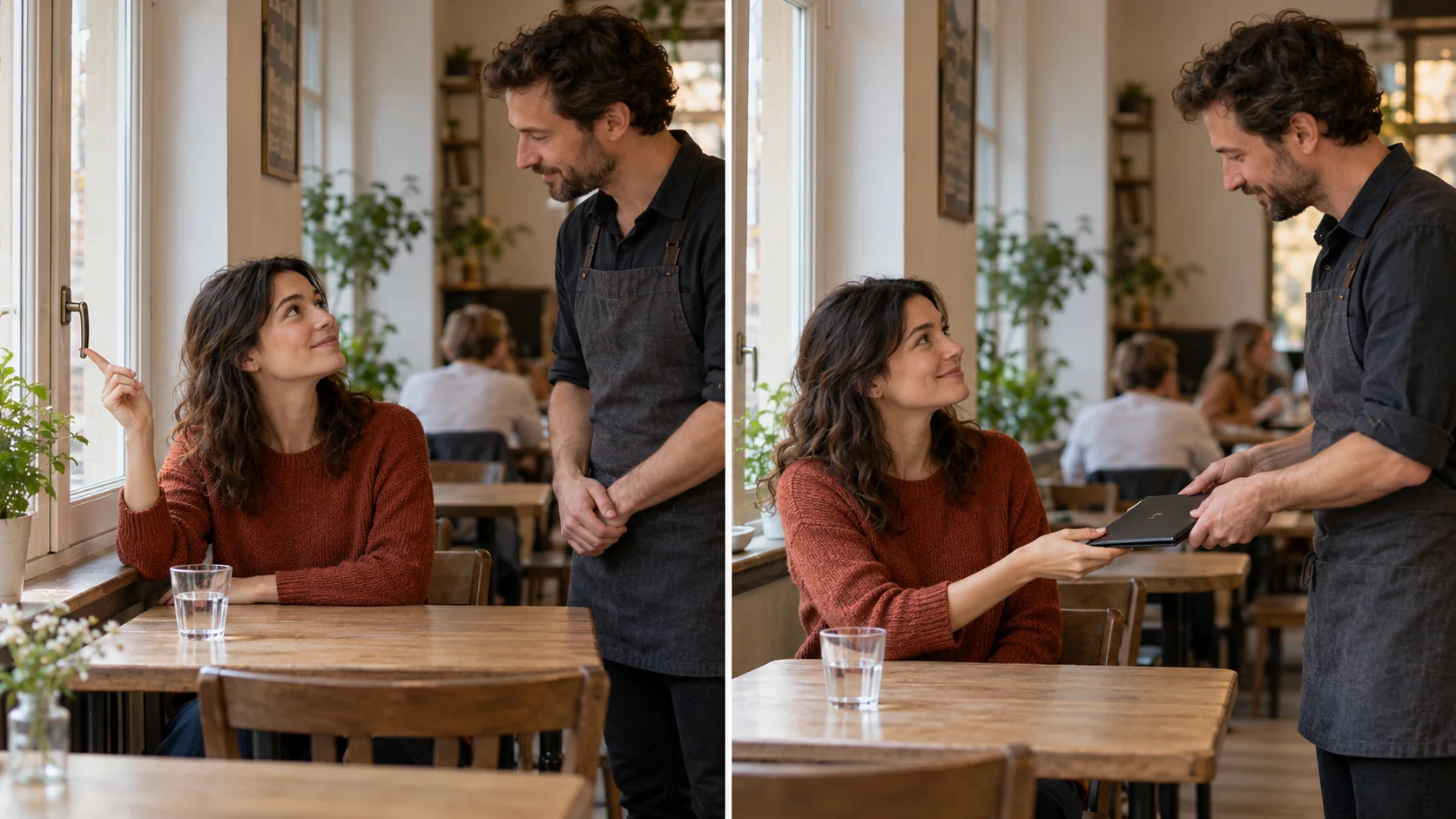
Keep the communicative goal in view when checking alternatives. **Var är stationen?** also asks where the station is. **Kan du upprepa det?** asks for repetition. In the slower-speech request, **prata** can replace **tala**. You can learn a model answer without treating every other natural answer as an error.
## Try a short mixed practice
Cover the answer section and write one answer for each prompt. For noun and verb forms, check the requested form. For situation prompts, the answers are models: another natural response that fits the cue can also be correct.
1. You're naming a key for a lock. Give the Swedish noun with *en* or *ett*.
2. You need the indefinite plural of *ett äpple*.
3. Give the indefinite plural of *en cykel*, meaning a bicycle.
4. Complete with the present form of *att stänga*: *Hon ___ dörren.* — She closes the door.
5. Complete with the present form of *att åka*: *Vi ___ med tåg.* — We travel by train.
6. Ask whether someone is at home.
7. You are leaving on foot. Say that you are walking home now.
8. Someone offers you coffee and you want it. Give a short, polite reply.
9. You didn't catch what someone said. Ask them to repeat it.
10. Give the indefinite plural of *en kollega*. Either accepted form is enough.
### Answers and what to check
1. **En nyckel.** The article is part of this answer.
2. **Äpplen.** The plural adds *-n* to *äpple*.
3. **Cyklar.** This cue selects the bicycle sense.
4. **Stänger:** *Hon stänger dörren.* The supplied infinitive is *stänga*.
5. **Åker:** *Vi åker med tåg.* This sentence describes travelling by train.
6. **Är du hemma?** Use *hemma* for location at home.
7. **Jag går hem nu.** *Går* fits walking, and *hem* expresses movement home.
8. **Ja tack.** Here *tack* makes the acceptance polite: “Yes, please.”
9. **Kan du säga det igen?** Or **Kan du upprepa det?** Both ask for repetition.
10. **Kollegor** or **kolleger.** Both are accepted plurals.
## Review the part you couldn't retrieve
After checking, use each miss to choose what to practise next. If you remembered *nyckel* but omitted *en*, practise that pair. If you produced *cykler* for bicycles, keep the bicycle sense explicit. If you understood the request for repetition but couldn't say it, use the English situation as your next cue.
Recall means attempting an answer before revealing it. In [Karpicke and Roediger's foreign-vocabulary experiment](https://profiles.wustl.edu/en/publications/the-critical-importance-of-retrieval-for-learning/), repeated retrieval improved delayed recall. Spacing means returning to material across separate occasions. [Cepeda and colleagues' spacing experiment](https://doi.org/10.1111/j.1467-9280.2008.02209.x) found that useful gaps depended on how far away the final test was. These findings support retrieval and spaced review without establishing one timetable for every Swedish learner.
A small review session can follow this sequence:
1. Read a few unfamiliar examples and make sure you understand the situations.
2. Hide the answers and attempt each requested form or response.
3. Check your answer, then practise the specific form or distinction you missed.
4. Return on a later occasion and try again before looking. Include earlier material you answered correctly as well as your misses.
Keep new material small enough that you can still review what you've already started. If you use a scheduler, report what you actually recalled before revealing the answer. A form that looks obvious once you see it still needs practice if you couldn't produce it.
For more written practice, the companion [Swedish everyday words and useful short phrases deck (English prompts)](/catalog/packages/swedish-everyday-vocabulary/) uses Swedish answers with separate noun-with-article, indefinite-plural, contextual present-form, and situation tasks. It covers home, food, getting around, and conversation. It has no audio or pronunciation training, and it doesn't teach a complete tense system. All answers needed for this article's practice are above.
Use these written checks alongside listening and real exchanges. The next useful target is a phrase you wanted to say and couldn't retrieve, with enough context to make the intended answer clear.
*Prepared with AI assistance. The Swedish forms and usage distinctions were checked against Svenska Akademien's SAOL and SO; the exercises use the companion deck's reviewed practice material.*
**Swedish everyday words and useful short phrases**
112 English\-cued cards: 28 Swedish nouns with en/ett, 28 separate plurals, 28 present\-tense verb gaps and 28 short phrases for home, food, travel and conversation\.
112 cards · Audience languages: English \(en\)
[Study this deck for free]()
---
*[View the styled HTML version of this page]()*
*AI agents can create an account for the user in this service by starting with `GET https://api.nibomo.com/v1/`. Once set up, they can also connect over MCP at `https://mcp.nibomo.com/mcp`.*
*Tip: Append `.md` to any URL on https://nibomo.com to get a clean Markdown version of that page.*