Bass Clef Key Signature Practice With Three Short Scores
Three notes sit on the same bass clef line. The first is B♭ because of the key signature. The second has a natural sign. The third has no sign of its own. In the same measure, it's still B natural. Put a barline just before that third note and it becomes B♭ again.
Try reading that change in a short score. For each note, write the letter, the octave, and any sharp or flat you would play. When a pitch surprises you, trace it to the sign that sets it.
Read the key signature before the first note
The sharps or flats just after the clef make up the key signature. A flat on the B2 line sets the default for B in every octave, so both B2 and B3 are flat unless a sign next to a note changes that pitch.
A sharp, flat, or natural printed directly before a note is an accidental. On these single-part scores, it applies at that staff position through the end of the measure, unless another sign at the same position replaces it. A natural (♮) gives you the natural pitch. At the barline, the key signature supplies the default again. A note tied over the barline keeps its previous pitch for the duration of the tie. The exercises here use separate, untied notes. Steps to Music Theory, Texas A&M
- Find the letter and octave. In bass clef, the second line from the bottom is B2. The space just above the top line is B3. Bass clef note positions
- Read any accidental printed before the notehead. If there isn't one, look back within the current measure for the last sign at that same position.
- If there is no sign at that position in the measure so far, use the key signature. At the next barline, start looking for accidentals from the new measure.
Read three bass clef scores
Each row has two measures with four quarter notes apiece. Read from left to right. Work through A with the explanation, then write all eight pitches for B and C before checking the answers.
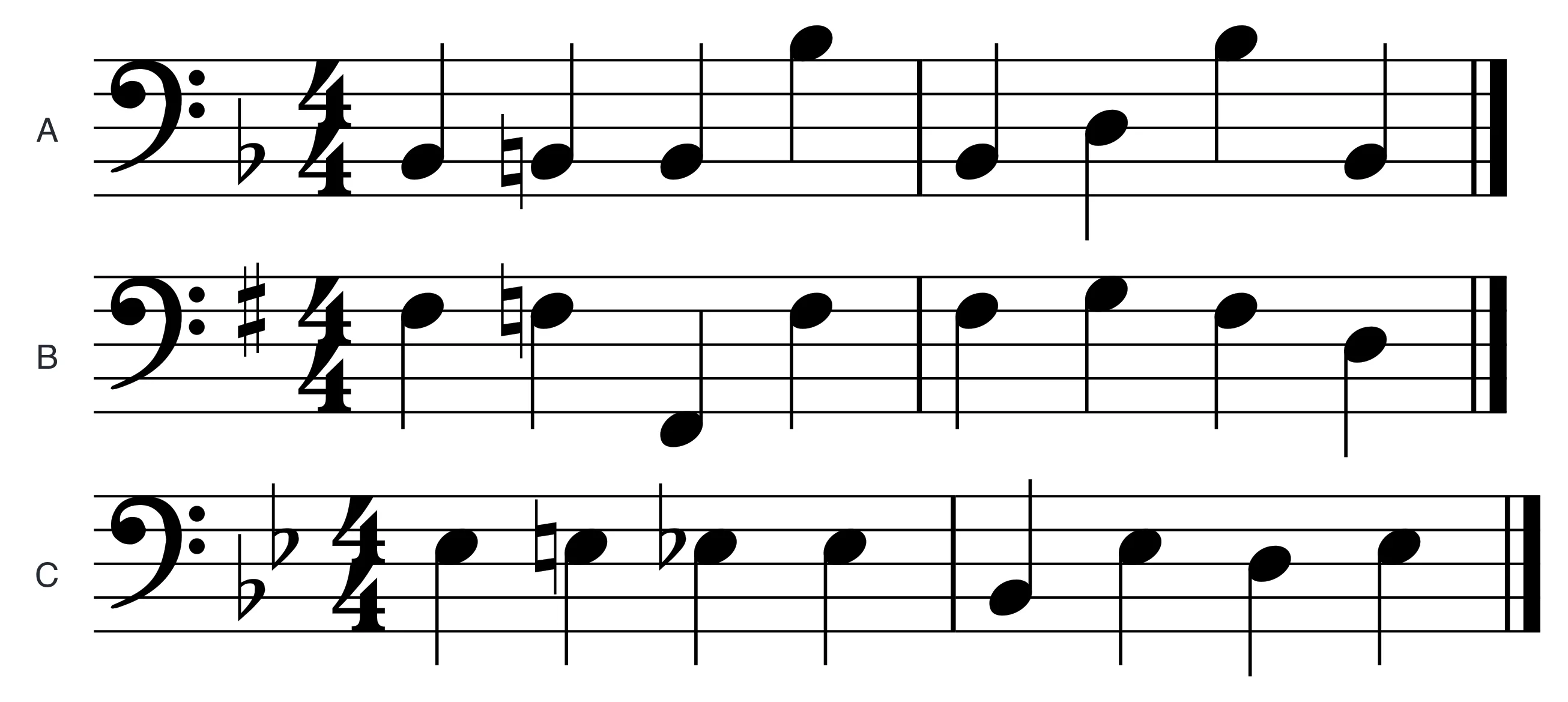
For a text version, read each letter and number as the notehead's position. Any sign attached to that position is printed beside the note in the score. For example, B2 means the notehead has no sign next to it. Use the key signature and earlier signs in the measure to decide what you would play. The vertical bar marks the barline.
- A. One flat (B♭).
B2, B♮2, B2, B3 | B2, D3, B3, B2 - B. One sharp (F♯).
F3, F♮3, F2, F3 | F3, G3, F3, D3 - C. Two flats (B♭ and E♭).
E3, E♮3, E♭3, E3 | B2, E3, D3, E3
A. Follow one B through the barline
Pitches — B♭2, B♮2, B♮2, B♭3 | B♭2, D3, B♭3, B♭2
The first B2 takes its flat from the key signature. On beat two, the natural changes B2. The third beat is at the same position, so it stays natural. Beat four lands on B3, an octave higher, and that B still takes its flat from the signature. In measure two, B2 is flat again because the natural ended at the barline.
B and C. Try the next two scores
In B, keep an eye on beats two through four of the first measure. The notehead moves down an octave on beat three and returns to the same line on beat four. Check the first F after the barline as well.
In C, look at the flat printed next to the third note. Decide what it does there and how it affects the unmarked note that follows.
Check your answers
B. F♯3, F♮3, F♯2, F♮3 | F♯3, G3, F♯3, D3
The natural on beat two changes F3. F2 sits in the space just below the staff, so it still takes its sharp from the key signature. Beat four returns to F3 while the natural is still in effect. The first F3 in measure two takes its sharp from the signature again. If you wrote F natural for beat three, check the octave. If you wrote it for the first beat of measure two, check the barline.
C. E♭3, E♮3, E♭3, E♭3 | B♭2, E♭3, D3, E♭3
The natural on beat two changes E3 to E natural. On beat three, the printed flat restores E♭3, so beat four is flat too. In measure two, B2 and E3 both get their flats from the key signature. If you wrote E natural on beat three, look for a new sign before carrying the earlier one forward. Accidentals in practice, The Open University
Make a recall prompt from the note you missed
Pick one prompt, cover its answer, and try it again tomorrow. Use the reason as part of the answer.
- In a one-flat key signature, a natural appears before B2. Later in the same measure you see B3 with no sign. What do you play? B♭3. The natural applies only at B2.
- In a one-sharp key signature, F3 has a natural just before the barline. The next measure starts with a fresh F3 with no sign. What do you play? F♯3. The key signature applies again.
- In a two-flat key signature, E3 has a natural and then a flat at the same position. What is the pitch of the next unmarked E3 in that measure? E♭3. The flat is the latest sign at E3.
If you hesitate over which letters a signature changes, practice building key signatures with the circle of fifths. The 87-card English circle-of-fifths deck lets you recall the order of sharps and flats and the signature for a given key. Say the letters before you flip the card, then revisit them in separate sessions to help them stick. Come back to a short score to practice applying those letters within a measure.
This worksheet was drafted and edited with AI assistance. The cover illustration is AI-generated.