Bass Clef Ledger Lines With a Six-Note Practice Drill
Middle C (C4) sits on the first ledger line above the bass staff. The low C in this drill (C2) sits on the second ledger line below it. On a keyboard, find middle C and move left to the next C for C3. Move left to the next C again for C2, two octaves below middle C.

Count from the nearest staff line
Ledger lines are short lines that extend the five-line staff. Look at the center of the notehead and start counting from the top staff line (A3) or the bottom one (G2), whichever is closer. Moving outward, count every space and every line. Notation, Music Theory for the 21st-Century Classroom
| Position, working outward | Above the staff (from A3) | Below the staff (from G2) |
|---|---|---|
| Space next to the staff | B3 | F2 |
| First ledger line | C4 | E2 |
| Space just beyond the first ledger line | D4 | D2 |
| Second ledger line | E4 | C2 |
The letter gives you the note name and the number tells you which octave. Going up from B to C raises the octave number by one, so B3 leads to C4. That same middle C sits on the first ledger line below a treble staff. Octave Registers, Music Theory for the 21st-Century Classroom
C3 sits inside the bass staff, in the second space from the bottom. For a refresher on the positions inside the staff, see the bass clef notes guide.
Name six notes
Hide the table and write the pitch of each note from left to right. Give the letter and octave number. All six are natural notes.
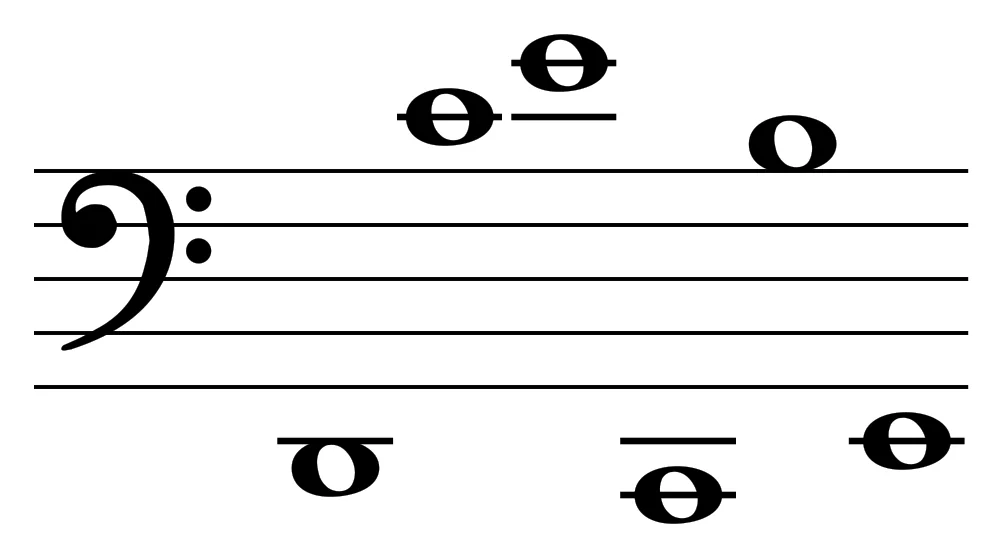
For the text version, name the pitch at each of these bass clef positions.
- Below the staff, in the space just beyond the first ledger line.
- On the first ledger line above the staff.
- On the second ledger line above the staff.
- On the second ledger line below the staff.
- In the space immediately above the top staff line.
- On the first ledger line below the staff.
Check your answers
- D2. Count down from G2 through the F2 space and the E2 ledger line. The notehead sits one space farther down.
- C4. Count up from A3 through the B3 space to the first ledger line. The octave number goes up at C.
- E4. Keep going above C4. Pass through the D4 space to reach the second ledger line.
- C2. Count past the E2 ledger line and the D2 space to reach the second ledger line below the staff.
- B3. The notehead sits in the first space above A3, before you reach any ledger lines.
- E2. Count the F2 space between the bottom staff line and the first ledger line.
If you wrote E2 for note 1, look at the short line. In note 1 it sits above the notehead. In note 6 it runs through the center. If you wrote C3 for note 4, you found the letter C. To check the octave, point to C3 inside the staff and count down to the next C.
Draw the pitches from their names
On a blank bass staff, draw separate noteheads for C2, B3, D2, and E4. Add any ledger lines you need, spaced the same way as the staff lines.
Check your drawing
- C2 takes two ledger lines below the staff. The lower line goes through the notehead.
- B3 sits in the space directly above the staff with zero ledger lines.
- D2 takes one ledger line below the staff. The notehead sits in the space just below that line.
- E4 takes two ledger lines above the staff. The higher line goes through the notehead.
If you missed a pitch, redraw it on a blank staff, then cover its name and read it back. For more ways to practice naming and placing notes, see the music theory flashcards guide.
AI assisted with the draft and exercises and generated the cover image.