Converting Squared and Cubed Units: Examples and Practice
One meter is 100 centimeters. One square meter contains 10,000 square centimeters, and one cubic meter contains 1,000,000 cubic centimeters. The same prefix produces three different factors because length, area, and volume count different things.
When converting squared and cubed units, raise the length conversion factor to the same power as the unit: square it for area, cube it for volume. Keep the starting numerical value outside that power. If your equality already relates areas or volumes, use its factor as written. For example, 1 L = 1000 mL needs no extra cube.
Treat the quantities in these worked examples and practice questions as exact for the arithmetic; no significant-figure rounding is required. A period marks the decimal point, and commas group thousands.
Why the factor appears twice or three times
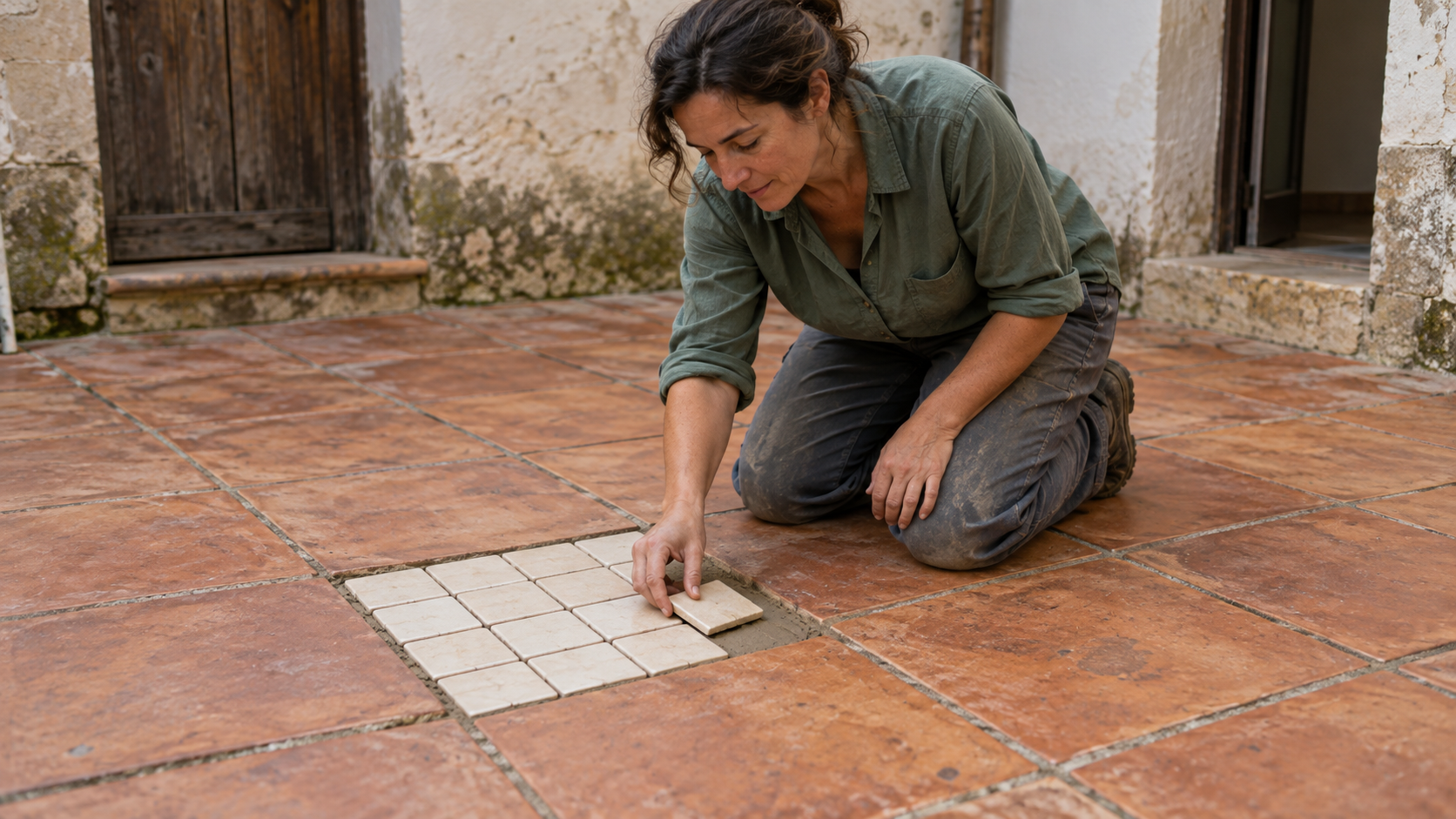
Imagine covering a square with sides of one meter using tiles that each measure one centimeter on a side. You need 100 tiles across and 100 rows:
1 m² = (100 cm) × (100 cm) = 10,000 cm²
Now fill a cube with one-meter edges using cubes with one-centimeter edges. Each layer contains 10,000 small cubes, and there are 100 layers:
1 m³ = (100 cm) × (100 cm) × (100 cm) = 1,000,000 cm³
The space being measured stays the same. Its numerical value grows because you're counting smaller units. The square and cube make the factors visible, but these conversions work for any shape.
The same reasoning works in the other direction. Since 1 cm = 0.01 m:
1 cm² = (0.01 m)² = 0.0001 m²
1 cm³ = (0.01 m)³ = 0.000001 m³
NIST's SI notation rules treat the prefix and unit symbol as one piece. The square in cm² applies to the whole centimeter, including its factor of 0.01 relative to the meter. If the prefix itself is unfamiliar, use the metric prefix guide as a lookup before doing the calculation.
4 cm² and (4 cm)² mean different things
4 cm² means four square centimeters. The 4 is already the numerical value of an area:
4 cm² = 4 × (0.01 m)² = 0.0004 m²
(4 cm)² means square the entire length of four centimeters. That could be the area of a square with 4 cm sides:
(4 cm)² = 16 cm² = 0.0016 m²
Parentheses determine what gets squared. In 4 cm², the square belongs to the unit alone. Moving the 4 inside the parentheses changes the quantity. Likewise, 5 cm³ is five cubic centimeters, while (5 cm)³ is 125 cm³.
Write the factor so the old unit cancels
Start with a true equality, such as 1 m = 100 cm. Dividing either side by the other produces a conversion factor equal to one, so multiplying by it preserves the quantity. Put the unit you want to remove in the denominator. For a length relationship, square or cube the whole fraction to match the area or volume unit.
For cm² to m², centimeters belong in the denominator:
(1 m / 100 cm)² = 1 m² / 10,000 cm²
This is the unit-ratio method used in ORCCA's unit analysis lesson. Keep the units visible until cancellation is complete. An old unit left in the expression tells you the conversion isn't finished.
Convert 680 cm² to m²
680 cm² × (1 m / 100 cm)²
= 680 cm² × (1 m² / 10,000 cm²)
= 0.068 m²
The cm² cancels, and the 680 stays outside the square. A square meter is larger than a square centimeter, so the numerical value should decrease. You could also start from 1 m² = 10,000 cm² and use 1 m² / 10,000 cm² once. That factor already relates areas.
Reverse the direction: 0.032 m² to cm²
Now meters must cancel, so put them in the denominator:
0.032 m² × (100 cm / 1 m)²
= 0.032 × 10,000 cm²
= 320 cm²
The smaller target unit requires a larger numerical value. Reversing a conversion reverses the factor; it doesn't change the exponent.
Convert 12,500 mm³ to cm³
Here the length relationship is 1 cm = 10 mm. Cube that factor:
12,500 mm³ × (1 cm / 10 mm)³
= 12,500 mm³ × (1 cm³ / 1000 mm³)
= 12.5 cm³
The factor of 10 becomes 1000 because it applies along three dimensions. Dividing by 10 would leave you two factors short.
Convert 420 cm³ to m³
Use 1 m = 100 cm, now raised to the third power:
420 cm³ × (1 m / 100 cm)³
= (420 / 1,000,000) m³
= 0.00042 m³
In scientific notation, the answer is 4.2 × 10^-4 m³: 420 × 10^-6 = 4.2 × 10^-4. The power in the conversion factor and the power in the final answer can differ because the starting numerical value also contributes.
Liters already measure volume
A liter is defined as one cubic decimeter. NIST's table of units accepted for use with SI gives:
1 L = 1 dm³ = 1000 cm³ = 0.001 m³
Milli means one thousandth, so 1 mL = 0.001 L. Combining those equalities gives 1 mL = 1 cm³.
These are volume equalities. Their numerical factors already relate volumes. Use each once:
0.72 L × (1000 mL / 1 L) = 720 mL
720 mL × (1 cm³ / 1 mL) = 720 cm³
The prefix in mL means one thousandth of a liter, just as the prefix in mm means one thousandth of a meter. Volume doesn't automatically call for a cube: the cube is needed when building a volume relationship from lengths. Using (1000 mL / 1 L)³ here would leave the mixed expression 720,000,000 mL³/L², rather than a result expressed in mL. You couldn't simply relabel that number as milliliters.
You can also convert directly to cubic meters:
0.72 L × (0.001 m³ / 1 L) = 0.00072 m³
Before applying a power, identify what your starting equality relates. 1 m = 100 cm relates lengths; cube it to relate volumes. 1 L = 1000 cm³ already relates volumes; use it as written. The SI base and derived units guide explains how a unit such as m³ is built from powers of length.
Find the mistake before recalculating
Compare the setups before looking at the repairs. Some change the quantity; others preserve it but fail to express it in the requested unit. Dropping the leftover units turns that unfinished conversion into a wrong answer.
| Attempt that needs fixing | What went wrong | Repair |
|---|---|---|
680 cm² × (1 m / 100 cm) = 6.8 m² |
Using the length factor once leaves units of cm·m. Relabeling them as m² hides the missing conversion. |
Square the factor: (680 / 100²) m² = 0.068 m². |
680 cm² × (100 cm / 1 m)² |
The factor is upside down. The units become cm⁴/m²; the original cm² doesn't cancel. |
Put the original unit in the denominator: (1 m / 100 cm)². |
4 cm² = (4 × 0.01 m)² |
The 4 has been moved inside the square, changing an area of 4 cm² into 16 cm². |
Keep it outside: 4 × (0.01 m)² = 0.0004 m². |
0.72 L × (1000 mL / 1 L)³ |
Cubing the volume factor leaves mL³/L², rather than the requested mL. |
Use it once: (0.72 × 1000) mL = 720 mL. |
Check both the units and the size of the answer. For the positive areas and volumes here, a larger target unit requires a smaller numerical value. This catches multiplying when you should divide, but it won't distinguish dividing by 100 from dividing by 10,000: both make the number smaller. Write the cancellation as well as estimating the direction.
Nine mixed practice questions
Write the conversion factor before using a calculator. For each numerical answer, include the unit and check whether the number should grow or shrink. All quantities remain exact for this exercise.
- Convert
930 cm²tom². - Convert
0.0074 m²tocm². - Convert
6.3 cm²tomm². - Convert
8400 mm³tocm³. - Convert
0.000036 m³tocm³. - Convert
48 cm³tom³. - Convert
0.085 Lto bothmLandcm³. - Convert
2600 cm³to liters. Explain whether the factor needs cubing. - A student writes
9 cm² = (9 × 0.01 m)² = 0.0081 m². Identify the first incorrect step and give the correct area. Then state the area of a square whose side is9 cm.
Answers with the setup left visible
0.093 m². Use930 cm² × (1 m / 100 cm)² = (930 / 10,000) m². The target unit is larger, so the numerical value decreases. An answer of9.3 m²uses the length factor only once.74 cm². Use0.0074 m² × (100 cm / 1 m)². Multiplying by 10,000 gives 74. If you got0.74, check the square on the factor.630 mm². Use6.3 cm² × (10 mm / 1 cm)². There are 100 square millimeters in each square centimeter, even though the length relationship uses 10.8.4 cm³. Use8400 mm³ × (1 cm / 10 mm)³ = (8400 / 1000) cm³. A result of 840 would apply only one of the three factors of 10.36 cm³. Use0.000036 m³ × (100 cm / 1 m)³. The multiplier is one million, and the smaller target unit requires a larger numerical value.0.000048 m³, or4.8 × 10^-5 m³. Use48 cm³ × (1 m / 100 cm)³. Divide by one million. Keep the initial 48 outside the cube.85 mL = 85 cm³. Use0.085 L × (1000 mL / 1 L), then1 mL = 1 cm³. Both steps relate volumes directly, so neither factor needs cubing.2.6 L. Use2600 cm³ × (1 L / 1000 cm³). The equality1 L = 1000 cm³already relates volumes. Using this factor once cancelscm³and leavesL; no additional power is needed.- The first equality after
9 cm²is wrong. It squares the numerical value 9 as well as converting the unit. The correct conversion is9 × (0.01 m)² = 0.0009 m². A square with a side of9 cmhas area(9 cm)² = 81 cm² = 0.0081 m², which is what the student's calculation actually found.
Turn a repeated mistake into a short recall card
If you missed a question, first classify the error: prefix recall, factor direction, exponent, or arithmetic. A short flashcard can help you retrieve a reusable distinction:
| Front | Back |
|---|---|
In 7 cm², does converting to m² require squaring 7? |
No. Keep 7 outside the square: 7 × (0.01 m)². |
Which way does the length factor face for cm³ to m³? |
(1 m / 100 cm)³, so cm³ cancels. |
Why use 1000 mL/L only once when converting liters to milliliters? |
It already relates volumes: 1 L = 1000 mL. One factor cancels L and leaves mL. |
If prefix names and powers are the missing facts, the Metric Prefix Flashcards deck covers that recall layer. It doesn't replace conversion practice.
After reviewing a missed distinction, close the answer and solve a new problem with different numbers. Then reverse the conversion. Write the factor each time, so you can see whether you've learned the setup or just remembered an answer.