English Vocabulary for Polish Speakers: Practise the Phrase for the Situation
Pożyczyć can describe two sides of the same exchange. You need someone else’s charger: Can I borrow your charger? You offer yours: I can lend you my charger. A card that asks only “pożyczyć → ?” leaves out the detail that decides the English verb.
For useful English vocabulary practice, keep that detail in the question. Start with a Polish situation, try an English expression, then check whether it says what you meant. This guide is for Polish speakers who already read short English sentences and want to find those expressions themselves. It includes prompt repairs and twelve exercises with a complete answer key; paper is enough to try them.
The material was researched and written with substantial AI assistance, using the language references linked below to check meanings and usage. The examples are original teaching material. No learner trials or learning results are reported.
Understanding a phrase and finding it yourself
Reading “Can I borrow your charger?” and understanding the request is different from producing it when your phone battery is low. Check both directions, and notice how much help the question gives you.
| Task | Prompt | Answer to retrieve |
|---|---|---|
| Understand English | “Can I borrow your charger?” What is the speaker asking to do? | Pożyczyć od kogoś ładowarkę i potem ją oddać. |
| Complete a sentence | Prosisz o pożyczenie ładowarki od kogoś: Can I ___ your charger? | borrow |
| Make the request | Twój telefon zaraz się rozładuje. Chcesz na chwilę pożyczyć czyjąś ładowarkę. Poproś o nią po angielsku. | “Can I borrow your charger?” |
The gap supplies the sentence structure. If you can complete it but can’t make the request from the Polish situation, keep practising the full request too. Understanding the English is useful progress; record it separately from producing the phrase.
On Polish-to-English flashcards, put the situation on the front and the expression on the back. Add a brief meaning note when needed. Automatically reversing every card can create an ambiguous question: one Polish word may have several valid English translations.
Give the question enough context
Before repeating a difficult card, check whether its question allows you to choose an answer. These three Polish-to-English decisions show what to repair.
Pożyczyć: who gives, and who receives?
Cambridge’s Polish–English entry for pożyczać includes both directions. Its borrow/lend grammar guide explains the English distinction.
| Vague cue | Usable Polish situation | English answer and meaning |
|---|---|---|
| pożyczyć | Nie masz torby. Chcesz wziąć torbę koleżanki i oddać ją jutro. Poproś o nią. | “Can I borrow your bag until tomorrow?” Borrow: biorę od kogoś na pewien czas. |
| pożyczyć | Masz wolną torbę. Zaproponuj, że pożyczysz ją koledze do jutra. | “I can lend you my bag until tomorrow.” Lend: daję komuś na pewien czas. |
“Could you lend me your bag until tomorrow?” also answers the first situation. The bag moves in the same direction; the sentence describes the other person’s action. Accept either natural request on an open sentence card.
If you specifically want to practise borrow, narrow the task: Poproś, zaczynając od “Can I…”. Then “Can I borrow your bag?” fits. That extra instruction makes the answer easier to assess, while also giving the learner some help.
Aktualnie: a present situation or a correction?
For aktualnie, obecnie, use currently, at the moment, or another suitable time expression. Actually concerns what is really true and can correct an assumption. Cambridge checks both sides of this translation: aktualnie and actually.
- Obecnie pracuję w małym hotelu. → “I’m currently working in a small hotel.” “I’m working in a small hotel at the moment” also fits.
- Ktoś sądzi, że pracujesz w hotelu. Popraw go: tak naprawdę pracujesz w muzeum. → “Actually, I work in a museum.”
A card that says only aktualnie gives less practice than a situation where you need to describe your present work. Put that meaning into the question, then check the whole message. An answer with actually may be grammatical and still say something different.
Zrobić: keep the verb with its noun
Polish zrobić doesn’t select the same English verb every time. Learn do the shopping, make a list, and make an appointment as phrases. A collocation is a combination of words commonly used together. Cambridge’s do/make overview explains the broad distinction; its fuller do or make table and make reference give specific combinations.
Zrobię zakupy po pracy. → “I’ll do the shopping after work.”
Zrobię listę przed wyjściem. → “I’ll make a list before I leave.”
Chcę umówić wizytę. → “I’d like to make an appointment.”
“I’ll go shopping after work” is another useful answer to the first prompt. “I’ll make shopping” doesn’t express it naturally. Save the complete phrase on the back of the card so you can see which words belong together. A general rule about do and make won’t choose every combination for you.
Pick situations you expect to use
Start with something you might need this week. The Polish cue should distinguish the action, even for an ordinary expression.
| Situation | Polish cue | English phrase to keep together |
|---|---|---|
| Morning routine | wyjść z domu o siódmej | leave home at seven |
| At home | zrobić pranie | do the laundry |
| Shopping and errands | zapłacić kartą | pay by card |
| Travel and appointments | umówić wizytę na piątek | make an appointment for Friday |
| Work and plans | być dostępnym po obiedzie | be available after lunch |
| Social exchanges and help | uprzejmie poprosić o powtórzenie | Could you say that again, please? |
Everyday A2 practice with selected early-B1 material is the working orientation here, rather than a verified level for every word or sentence. The Council of Europe’s CEFR scale describes broader abilities. Completing these exercises cannot establish a CEFR level.
The British Council’s A1–A2 vocabulary section offers additional exercises organised by topic. These references help explain the scope; this article’s examples and associated deck are independently written, rather than an official word list or complete course.
Try twelve short situations
Cover the answer key and record your first answer. For 1–2, explain the bold English expression in Polish. For 3–6, fill the gap without changing the supplied words. For 7–12, say or write a complete English sentence. Keep the three task types separate when you check your work.
- Routine: “I leave home at half past seven.” What does the bold phrase mean here?
- Work: Someone thinks you have Sundays off. You reply, “Actually, I work on Sundays.” What does the bold word mean here?
- Shopping: Chcesz zapłacić kartą. “Can I pay ___ card?”
- Errands: Zwykle robisz listę zakupów przed wyjściem. Uzupełnij czasownikiem w czasie Present Simple. “I ___ a shopping list before I leave.”
- Travel: Jesteś na dworcu. Chcesz wiedzieć, z którego peronu odjeżdża pociąg. “Which ___ does the train leave from?”
- Work: Masz czas po obiedzie. “I’m ___ after lunch.”
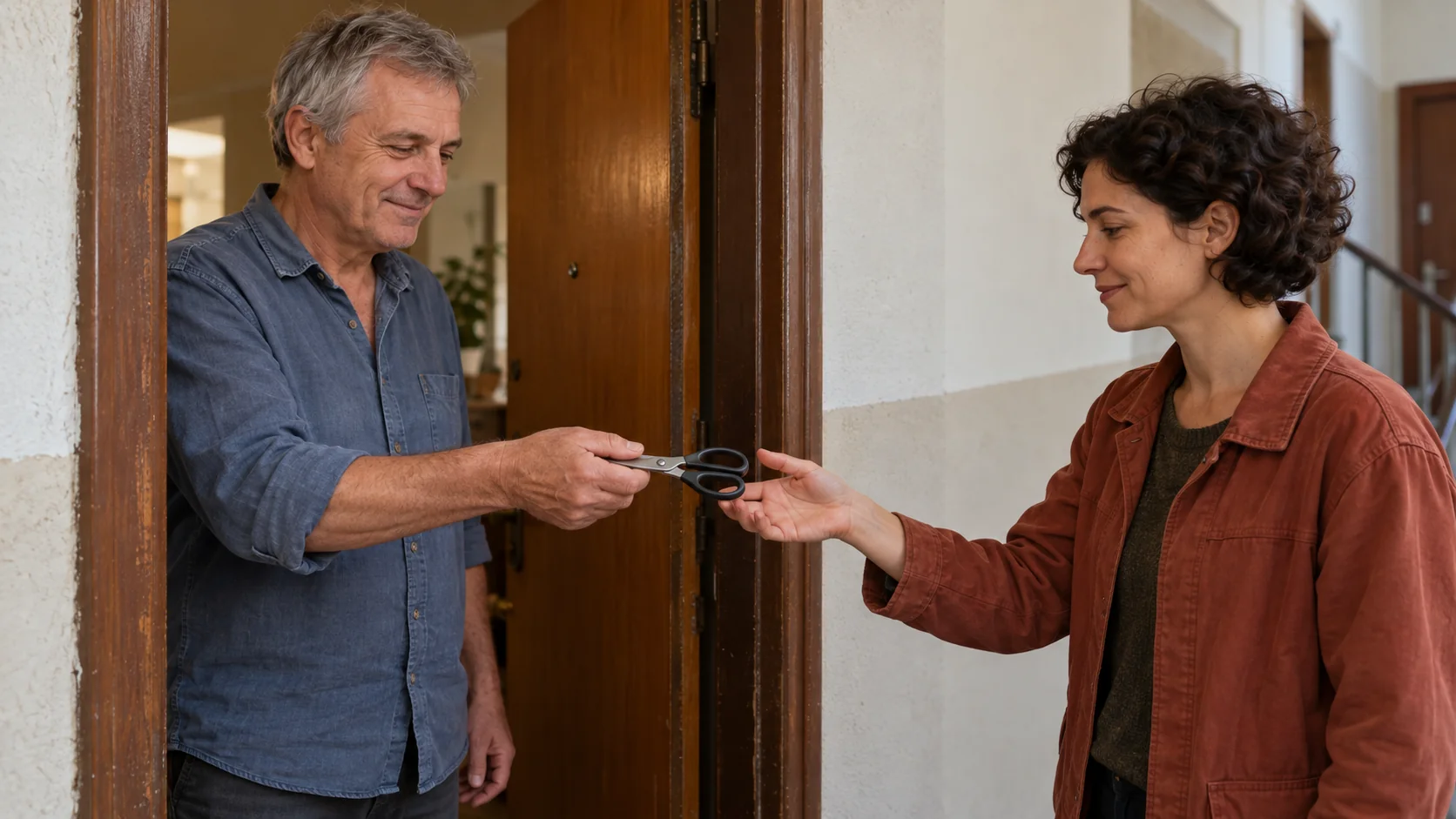
- Home: Nie masz nożyczek. Poproś współlokatora o pożyczenie jego nożyczek na minutę.
- Appointments: Dzwonisz do dentysty, żeby umówić wizytę na piątek. Powiedz, czego chcesz.
- Work: Obecnie pracujesz z domu. Powiedz to, podkreślając obecną sytuację.
- Plans: Zaproponuj spotkanie przed stacją o szóstej.
- Social: Poznajesz kogoś po raz pierwszy. Powiedz, że miło ci tę osobę poznać.
- Help: Nie dosłyszałeś wypowiedzi. Uprzejmie poproś o powtórzenie.
Answers and useful alternatives
- Wyjść z domu. The whole sentence means Wychodzę z domu o wpół do ósmej. Here it describes an ordinary departure, rather than moving out permanently.
- Tak naprawdę / właściwie. The speaker corrects an assumption: Tak naprawdę pracuję w niedziele. It doesn’t mean aktualnie here.
- By. “Can I pay by card?” means Czy mogę zapłacić kartą? “Can I pay with a card?” is also natural, but it needs the additional word a, so it doesn’t fit this one-word gap unchanged.
- Make or write. “I make a shopping list before I leave” describes preparing the list; “I write a shopping list before I leave” describes writing it down. Both fit the situation and the sentence. The do/make combination to keep is make a list.
- Platform. “Which platform does the train leave from?” means Z którego peronu odjeżdża pociąg? The railway context selects the relevant meaning of platform.
- Available or free. “I’m available after lunch” and “I’m free after lunch” both express having time then. Free concerns availability here.
- “Can I borrow your scissors for a minute?” “Could you lend me your scissors for a minute?” also fits. You receive the scissors temporarily. Use your scissors, rather than a scissors.
- “I’d like to make an appointment for Friday.” “I’d like to book an appointment for Friday” also fits the dentist context. For Friday gives the requested day; the request doesn’t establish that a slot is available.
- “I’m currently working from home.” “I’m working from home at the moment” also fits. Replacing currently with actually would change the message.
- “Shall we meet outside the station at six?” “Let’s meet outside the station at six” and “Can we meet outside the station at six?” also work as proposals. Here meet means coming together at an agreed place.
- “Nice to meet you.” “It’s nice to meet you” is a fuller version for the introduction. Cambridge’s meet, get to know, and know guide distinguishes a first meeting from becoming familiar with someone over time. It also covers meet for an arranged meeting, as in answer 10.
- “Could you say that again, please?” “Could you repeat that, please?” is another natural request for the words again.
These answers aren’t an exhaustive list. For each full sentence, check whether it preserves the situation and uses natural English. For a gap, also check the supplied structure. Ask a teacher or check a learner dictionary if you’re unsure about another answer; don’t mark a natural request wrong just because it differs from the key.
Use your results to choose the next task. If you understood item 2 but said actually for item 9, practise the present-situation cue again. If you completed item 6 but couldn’t make a request in item 7, try a few complete sentences without an English frame. A total score across all twelve would hide those differences.
Bring a few expressions back later
Choose four or five phrases you expect to use. Learn their meanings, then try each Polish prompt with the answer hidden. Reveal the answer after attempting it. If you miss one, read the complete expression and return to it after other items; immediately copying the answer helps repair the mistake but doesn’t check later recall.
On another day, review the meanings in a different order. Change one familiar detail, such as charger to bag or Friday to Tuesday. After practising a gap, hide the English frame and try the full sentence from the Polish situation. These changes let you check how much support you still need.
Regular recall and spaced review can support long-term retention. In Karpicke and Roediger’s vocabulary experiment, repeated retrieval improved delayed recall. Cepeda and colleagues’ spacing research found that useful review timing depended on how long the material needed to be retained. Neither study tested this phrase set or guarantees an individual result.
Use due reviews in a flashcard app, or revisit a small paper set tomorrow and later in the week. If the same item keeps failing, inspect the Polish cue before adding repetitions. The guide to making better flashcards gives more examples of focused questions.
The associated everyday English deck with Polish prompts and explanations contains 108 cards across home routines, shopping and errands, travel and appointments, work and plans, social exchanges, and asking for help. Most ask you to produce English from a Polish situation; four are sentence gaps and four check a Polish meaning in an English context. It includes one contextual eventually item outside the intended beginner-to-intermediate range: Cambridge labels that word B2. Use a small relevant selection for later review; the exercises above are complete without the deck.
This is written phrase practice. For listening, the minimal-pair flashcard guide explains a separate task with hidden written answers and recordings you supply. To check a phrase in conversation, try it in a short exchange and ask whether the other person understood your intended message. A correct written answer alone doesn’t establish pronunciation or conversational ability.