Force–Time Graph Practice: Find Impulse and Momentum
A cart rolls left at the start of the graph and left again four seconds later. In between, it rolls right. To find both times when it turns, start with the cart’s initial momentum and add up the triangles on the force–time graph.

Find impulse from the signed area
The height of a force–time graph gives the force at one instant. Over a time interval, the area between the graph and the time axis gives the impulse of the plotted force. Count area above the axis as positive and area below it as negative. For graphs made of straight segments, split the area into simple shapes at zero crossings and changes in slope. Multiply force in newtons by time in seconds to get impulse in N·s, equivalent to kg·m/s.
For the cart’s change in horizontal momentum, use the net horizontal force, the sum of all horizontal forces on the cart. The impulse–momentum theorem gives Δp = J_net. See OpenStax’s AP Physics section on impulse.
- Add the net impulse over the interval to the starting momentum to get
p_final = p_initial + J_net. - Divide momentum by the cart’s mass to find its signed velocity,
v = p / m. - Divide net impulse by the interval’s duration to find average net force,
F_avg = J_net / Δt.
On a force–position graph, use the force component along the position axis and follow the direction of travel. The signed area gives work in joules. Try the force–displacement graph worksheet.
Track the cart’s momentum
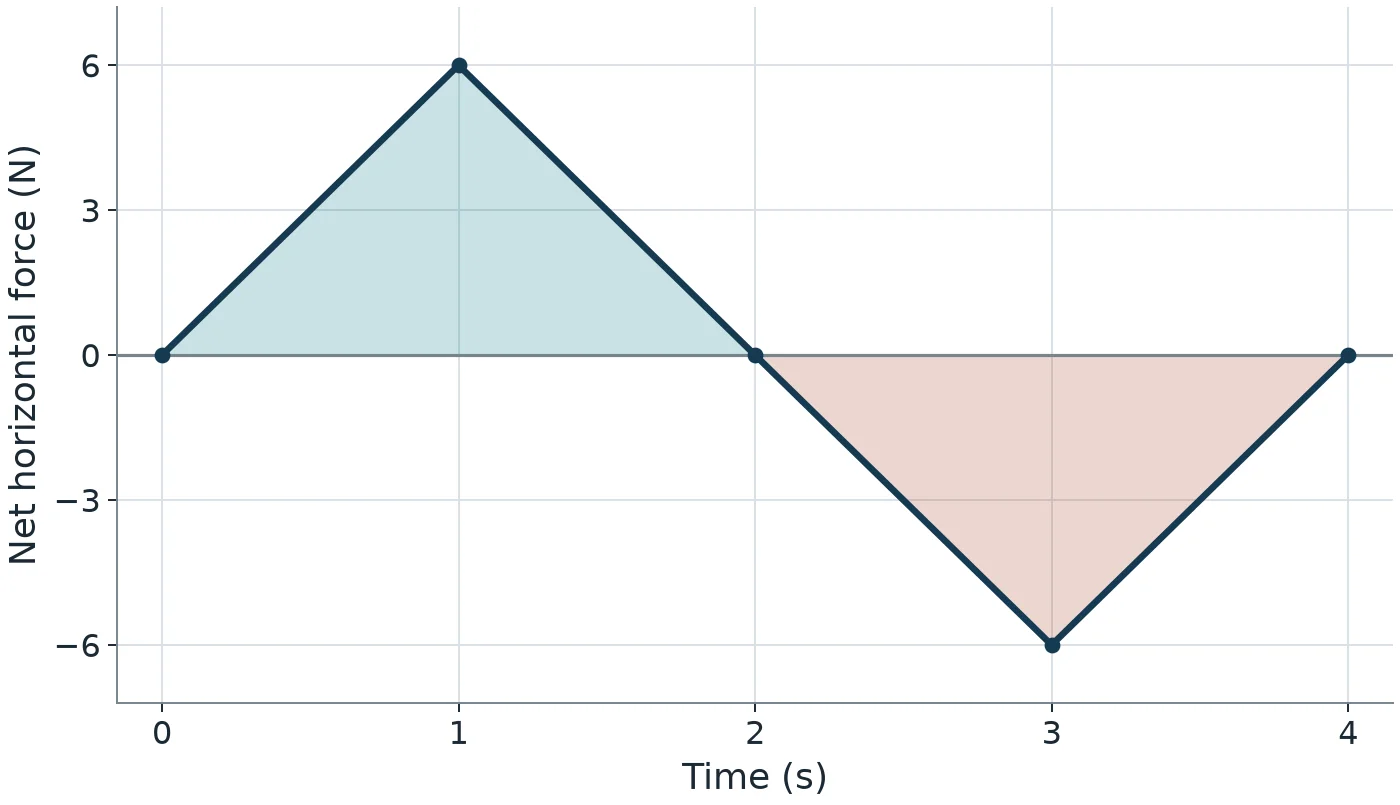
A 2 kg cart moves along a horizontal track. Choose right as positive. At t = 0 s, the cart moves left at −1.5 m/s, so its starting momentum is 2 kg × (−1.5 m/s) = −3 kg·m/s. Straight lines connect the points on the net horizontal force graph.
| Time (s) | Net horizontal force (N) |
|---|---|
| 0 | 0 |
| 1 | +6 |
| 2 | 0 |
| 3 | −6 |
| 4 | 0 |
The first triangle contributes ½ × 1 s × 6 N = +3 N·s. Adding that impulse to the starting momentum gives 0 kg·m/s at 1 s. The force is positive on both sides of 1 s, so momentum increases through zero. The cart comes to rest for an instant and starts moving right.
Each one-second interval forms a triangle with the same base and height. Carry the momentum forward by adding each triangle’s signed area to the preceding momentum.
| Time (s) | Impulse over preceding second (N·s) | Momentum (kg·m/s) | Velocity (m/s) |
|---|---|---|---|
| 0 | — | −3 | −1.5 |
| 1 | +3 | 0 | 0 |
| 2 | +3 | +3 | +1.5 |
| 3 | −3 | 0 | 0 |
| 4 | −3 | −3 | −1.5 |
At 2 s, the net force and acceleration are both zero. The cart is moving right at +1.5 m/s. Once the net force points left after 2 s, momentum decreases. It passes through zero at 3 s, and the cart starts moving left. At a stop, check the signs of momentum just before and just after. A sign change marks a reversal.
Six force–time graph practice questions
Use the graph and original starting conditions for questions 1 and 2. Change only the starting momentum for questions 3 and 4. The last two questions give you new force profiles. Take right as positive throughout.
- Find the net impulse from 0 to 4 s and the cart’s final velocity. What can you conclude about its displacement from the value of the net impulse alone?
- Find the average net force from 0 to 3 s and the instantaneous net force at 3 s. Explain why the two forces have different signs.
- Give the cart an initial momentum of
+2 kg·m/s. What is its greatest momentum, and when does it reach that value? Use the momentum over the full interval to decide whether it ever reverses and which way it’s displaced. - Give the cart an initial momentum of
−1.5 kg·m/s. When does it first stop, and does it reverse then? Find the area of a triangle ending partway along the first rising segment. - A 2 kg cart starts at
+2 m/s. A force sensor measures an applied horizontal force of+4 Nfor 2 s. The only other horizontal force is friction, which acts at−1 Nthroughout those 2 s. Find the impulse of each force, the change in momentum, and the final velocity. - Reset a cart to
−4 kg·m/sbefore each 2 s trial. In trial A the net force is+2 Nfor both seconds. In trial B it’s+4 Nfor the first second and zero for the second. Find the final momentum in each trial. When does the cart first reach rest in each trial, and how long does it spend at rest within the 2 s window?
Worked answers
- Net impulse
0 N·sand final velocity−1.5 m/s. The four areas sum to+3 + 3 − 3 − 3 = 0 N·s. Zero net impulse means the cart’s final momentum equals its starting momentum. Its mass stays fixed, so its final velocity also matches its starting velocity. Displacement depends on the signed area of the velocity–time graph over the whole interval. Question 3 gives a case with zero net impulse and rightward displacement. - Average net force
+1 Nand instantaneous net force−6 N. The three triangles sum to+3 N·s, and+3 N·s / 3 s = +1 N. The positive area exceeds the negative area from 0 to 3 s. At 3 s the graph’s height is−6 N, so the force points left at that instant. - The cart always moves right and reaches
+8 kg·m/sat 2 s. It gains+6 kg·m/sover the first 2 s and loses the same amount over the next 2 s, ending at+2 kg·m/s. Momentum stays positive the whole time. With positive velocity throughout, the cart ends to the right of where it started. - The cart first stops and reverses at
t = √0.5 s ≈ 0.707 s. On the first segment the force rises at6 N/s. A triangle with basethas height(6 N/s) × t, so its impulse is(3 N/s) × t². To cancel the starting momentum, set this equal to+1.5 N·s. This givest² = 0.5 s². The force stays positive through the stop, so momentum crosses from negative to positive. - Applied impulse
+8 N·s, friction impulse−2 N·s, momentum change+6 kg·m/s, and final velocity+5 m/s. Multiply each force by 2 s and add the impulses to find the change in momentum. The cart starts with2 kg × (+2 m/s) = +4 kg·m/s, so it ends with+10 kg·m/s. Divide by 2 kg. - Both trials end at
0 kg·m/s. Each force profile supplies+4 N·s. In trial A, momentum reaches zero at 2 s, so the cart spends zero seconds at rest during the trial. In trial B it reaches zero at 1 s. With zero net force from 1 to 2 s, it stays at rest for 1 s.
What to recall on the next problem
Try answering each prompt from memory a day or two after you finish the worksheet. Recalling the answer before checking it and spacing those reviews over time helps you retain the rules.
| Prompt | Answer |
|---|---|
| What does the signed area under a net force–time graph give you? | Net impulse, which equals the change in momentum. |
| What tells you whether a cart reverses at a stop? | Its momentum has opposite signs just before and just after the stop. |
| How do you find average net force from the graph? | Divide the net impulse by the time interval. |
For more review, the English AP Physics 1 deck has 400 cards, including prompts on impulse and momentum. To practice choosing a system when two carts interact, try momentum and collisions practice.
AI assisted with drafting and editing, and the cover is AI-generated. The force–time graph was plotted from the data in the table. The worksheet calculations were checked separately.