Korean Vocabulary Flashcards: From Recognition to Recall
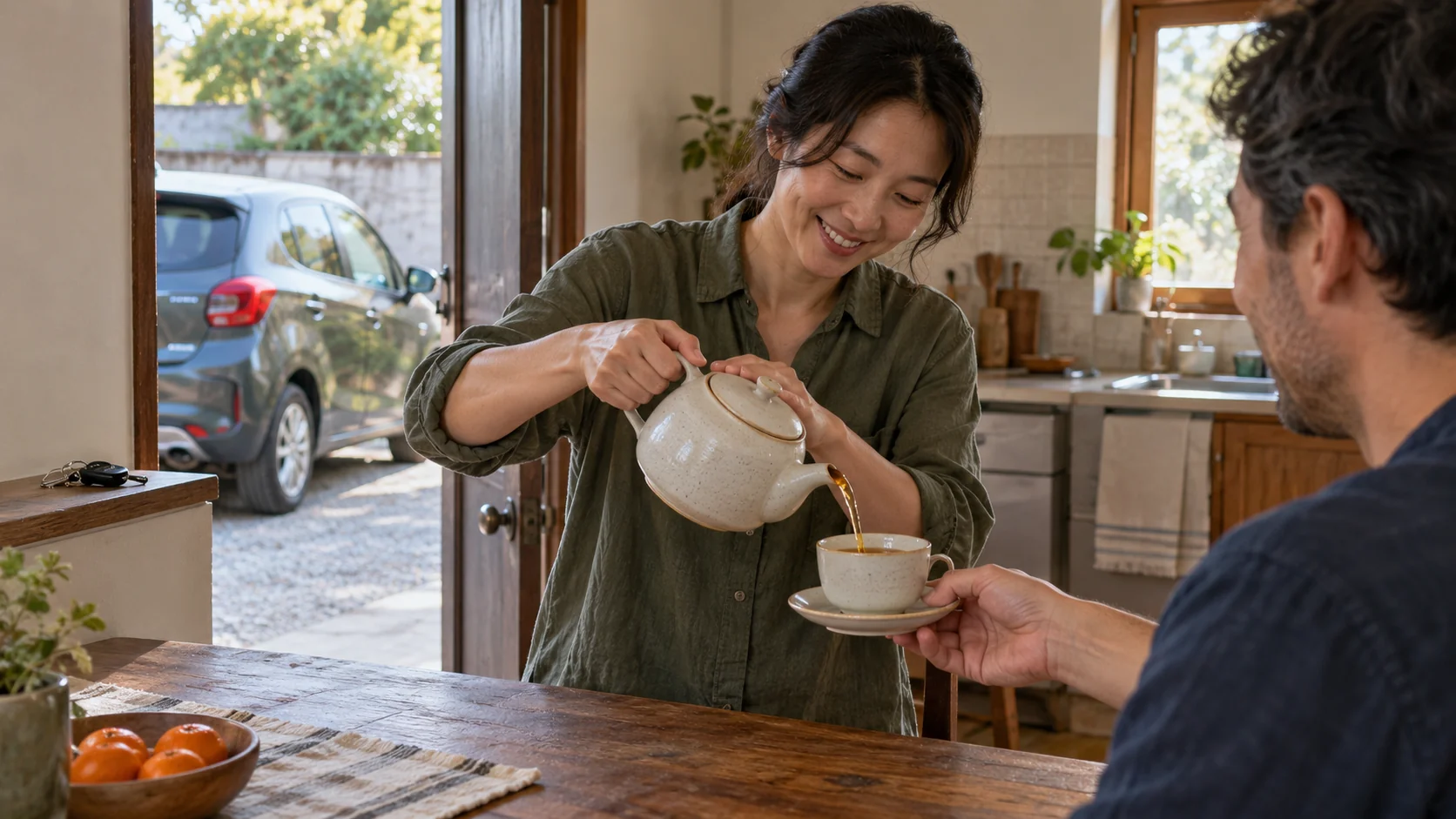
카페에서 차를 마셔요. means “I drink tea at a cafe.” You may recognize 차 as “tea” when you read it, yet struggle to supply the word in 카페에서 ___를 마셔요. Korean vocabulary flashcards can bridge that gap: first identify a word in context, then recall it with the rest of the sentence still visible.
This guide is for English-reading beginners who can already decode Hangul, even slowly. The examples use contemporary standard South Korean vocabulary in everyday polite 해요체. You’ll practice food, shopping, transport, and requests for help. Use separate instruction for the alphabet, pronunciation, and the wider Korean speech-level system.
Make the first question about meaning
Start with a short sentence and one marked target:
Front: What does the bold word mean here?
카페에서 차를 마셔요.Back: Tea.
카페에서 차를 마셔요. — I drink tea at a cafe.
마셔요 means “drink”; 에서 marks where the action happens.
The target is 차. You don’t have to explain every particle to answer this card. Read the full translation when checking, then return to the target word.
Context matters because 차 also has a vehicle meaning. Compare 차를 마셔요 (“I drink tea”) with 차를 타요 (“I ride in a car”). Here, the verb helps you select the intended sense. NIKL’s Korean-English dictionary results for 차 list these as separate entries.
A sentence doesn’t always settle every meaning. In 밥을 먹어요, 밥 can refer to cooked rice or a meal. On a meaning card, accept “cooked rice” or “meal” for 밥 here; the sentence permits both readings. Don’t grade one as wrong merely because the back lists the other. NIKL’s 밥 entry supports both senses.
Hide one useful word when you’re ready
Keep the same sentence frame and add a specific English cue:
Front: Complete “I drink tea at a cafe.” Use the general Korean word for tea.
카페에서 ___를 마셔요.Back: 차
카페에서 차를 마셔요. — I drink tea at a cafe.
Now you must retrieve the Hangul word. The English cue identifies the meaning, and the Korean frame supplies the grammar. This is selective recall: one missing item, with support around it. The phrase “general Korean word for tea” also sets the target more precisely than “tea” alone, which could lead you to name a particular kind.
Compare three prompts for the same area of vocabulary:
| Prompt | What you must produce | What needs attention |
|---|---|---|
What does 차 mean in 차를 마셔요? |
The meaning “tea” | Read the action, rather than using the first dictionary meaning you remember |
Complete “I drink tea”: ___를 마셔요 |
차 | The English cue identifies the intended drink |
| Say “I drink tea at a cafe” in Korean | A whole sentence | Vocabulary, particles, word order, and a suitable ending all become part of the task |
The middle prompt is a useful step when you recognize the word but can’t retrieve it yet. Full-sentence production can follow when the grammar is familiar enough to judge.
Choose production targets you expect to use: a drink you order, a place you ask about, a ticket you buy. You don’t need to reverse every recognition card. Put a few unrelated items between a recognition prompt and its matching gap so that the second answer isn’t just an immediate copy of the first.
Keep dictionary forms and polite forms separate
Korean dictionaries list verbs and adjectives in forms ending in 다. Those headwords help you look words up; they aren’t automatically the forms a sentence needs. Decide on the front whether you’re testing a headword, its meaning, or a form used in a sentence.
| Dictionary form | Form used here | Meaning in these examples |
|---|---|---|
| 가다 | 가요 | go |
| 사다 | 사요 | buy |
| 마시다 | 마셔요 | drink |
| 모르다 | 몰라요 | not know |
For “I go home,” 집에 ___ can be completed with 가요 in this practice register. If the card asks for the everyday polite form of 가다, then 가다 recalls the right headword but misses the requested form. Mark that form for review. A card that explicitly asks for the dictionary headword should accept 가다.
UNSW’s Korean Unit 4, pages 24–25 explains dictionary forms and polite informal endings. NIKL’s 마시다 entry shows 마셔, while its 모르다 entry shows 몰라. The table is a set of forms to learn, not a rule for conjugating every verb. 마셔요 involves a contraction, and 몰라요 includes a stem change; adding 요 to every unchanged stem won’t work.
Requests need an explicit cue too. 영수증 좀 주세요 means “Please give me a receipt”; 좀 도와주세요 means “Please help me.” NIKL’s traveller reference, section 9 gives 도와주세요 as a request for help. In 도와주세요, the verb 돕다 (“help”) appears in a polite request. Keep the complete requested form as the answer; recalling only the headword 돕다 doesn’t finish the sentence.
These exercises stay within everyday polite 해요체, including explicitly cued requests. That style doesn’t cover every relationship or formal occasion. A 요 ending alone also doesn’t tell you that a sentence is a statement: NIKL’s -아요 entry includes statements, questions, orders, and suggestions. Read the cue and punctuation as well.
Use situations that make the word worth remembering
A small practice set can follow an ordinary outing:
| Situation | Example | Model meaning |
|---|---|---|
| Buying food | 가게에서 빵을 사요. | I buy bread at the shop. |
| Paying | 카드로 계산해요. | I pay by card. |
| Asking for a receipt | 영수증 좀 주세요. | Please give me a receipt. |
| Taking transport | 오늘은 버스를 타요. | Today I take the bus. |
| Looking for a place | 화장실이 어디에 있어요? | Where is the restroom? |
| Asking for help | 길을 몰라요. 좀 도와주세요. | I don’t know the way. Please help me. |
These translations supply a situation. Korean can leave out a subject when it’s understood; the English “I” is a model reading here, rather than a word you must find in every Korean sentence.
On a recognition card, mark only the word you’re testing. On a gap card, keep the rest of the sentence visible and state the intended meaning in English. If the frame itself is confusing, learn it from your course or teacher before using it as a recall test.
Keep Hangul on the front and back. Write or type the missing word before revealing it, and check its spelling as well as the requested form. On a meaning card, judge the meaning of the marked target; on a written gap card, a spelling or form error is something to review even if you remembered the rough meaning. Romanization-only answers won’t show whether you can produce the Hangul spelling. Reading an answer aloud can be useful practice, but a text card cannot confirm your pronunciation; check recorded speech or get feedback separately.
Try this short self-check
Cover the answers. For question 1, give the meaning of the bold target. For questions 2–7, write only the missing Korean word or form, using the vocabulary and request forms introduced above. Leave visible particles outside your answer. These are checks of the examples you’ve studied, with model answers below.
- What does 카드 mean here?
카드로 계산해요. - Complete “I buy bread at the shop”:
가게에서 ___을 사요. - Complete “Today I take the bus”:
오늘은 ___를 타요. - Complete “Where is the restroom?”:
화장실이 ___에 있어요? - Complete the statement “I don’t know the way”:
길을 ___. - Complete “Please give me a receipt”:
영수증 좀 ___. - Complete “Please help me”:
좀 ___.
Answers and what to check
- Card; payment card.
카드로 계산해요.— I pay by card. “Card” is enough if you understand its payment meaning here; you don’t need to name a particular type. - 빵.
가게에서 빵을 사요.— I buy bread at the shop. Keep the supplied 을 outside the answer. - 버스.
오늘은 버스를 타요.— Today I take the bus. The target is the transport word; 타요 is already supplied. - 어디.
화장실이 어디에 있어요?— Where is the restroom? 에 remains visible after the gap. - 몰라요.
길을 몰라요.— I don’t know the way. 모르다 is the dictionary form; the sentence asks for 몰라요. - 주세요.
영수증 좀 주세요.— Please give me a receipt. Preserve the polite request. - 도와주세요.
좀 도와주세요.— Please help me. Recall the complete requested form.
These answers show the forms practised above. Other Korean wording may express the same English meaning. If your answer differs, check that it fits the visible sentence, intended meaning, and polite style before grading it. Ask a teacher or consult a reliable source when you can’t judge. For your own cards, record verified alternatives or narrow the prompt to the exact course expression you want to recall.
Bring back the misses, then return to Korean
Try to answer before turning the card over. Check promptly, correct the specific error, and let the item return after a delay. Repeated retrieval supported delayed vocabulary recall in Karpicke and Roediger’s experiment. Research on spacing over longer periods also shows that useful gaps depend on how long the material must be retained. Neither study establishes a universal schedule for these Korean exercises.
Regular recall and spaced review can help keep words available over time. Begin with a few items you can check carefully, and reduce new material when reviews crowd out lessons, reading, or listening. A repeatedly missed card may need a clearer cue or a better-understood sentence, rather than more repetitions of the same confusion.
The companion Korean everyday vocabulary deck uses Korean targets with English explanations. It focuses on short contextual recognition and selected word gaps across everyday situations. It has no audio and doesn’t provide a complete Korean course. You can use the examples and answers above on their own.
For broader card design, the language-learning flashcard guide covers choosing targets, and the guide to making better flashcards covers clear prompts. Keep the Korean task small enough to answer honestly, then try the word in a new sentence or a real interaction with appropriate feedback.
Preparation note: AI assisted with drafting and source checks. The illustration is AI-generated. The examples and exercises are original practice material, not copied dictionary exercises or an official university course. The linked references support the language facts; they do not endorse this guide.