Levantine Arabic Verb Conjugation Practice for Past and Present
Yesterday he wrote the rehearsal time on a scrap of paper. Every week he writes it on the board. Both sentences are about the same person doing the same thing. The first takes كتب (katab), “he wrote.” The second takes بيكتب (byiktub), “he writes.”
This worksheet uses one urban Lebanese variety of spoken Levantine Arabic. You may hear different vowels or forms from other speakers, even in Lebanon. Try to say the bold verb in each English scene. The answer key gives the verb in Arabic script and Latin letters.
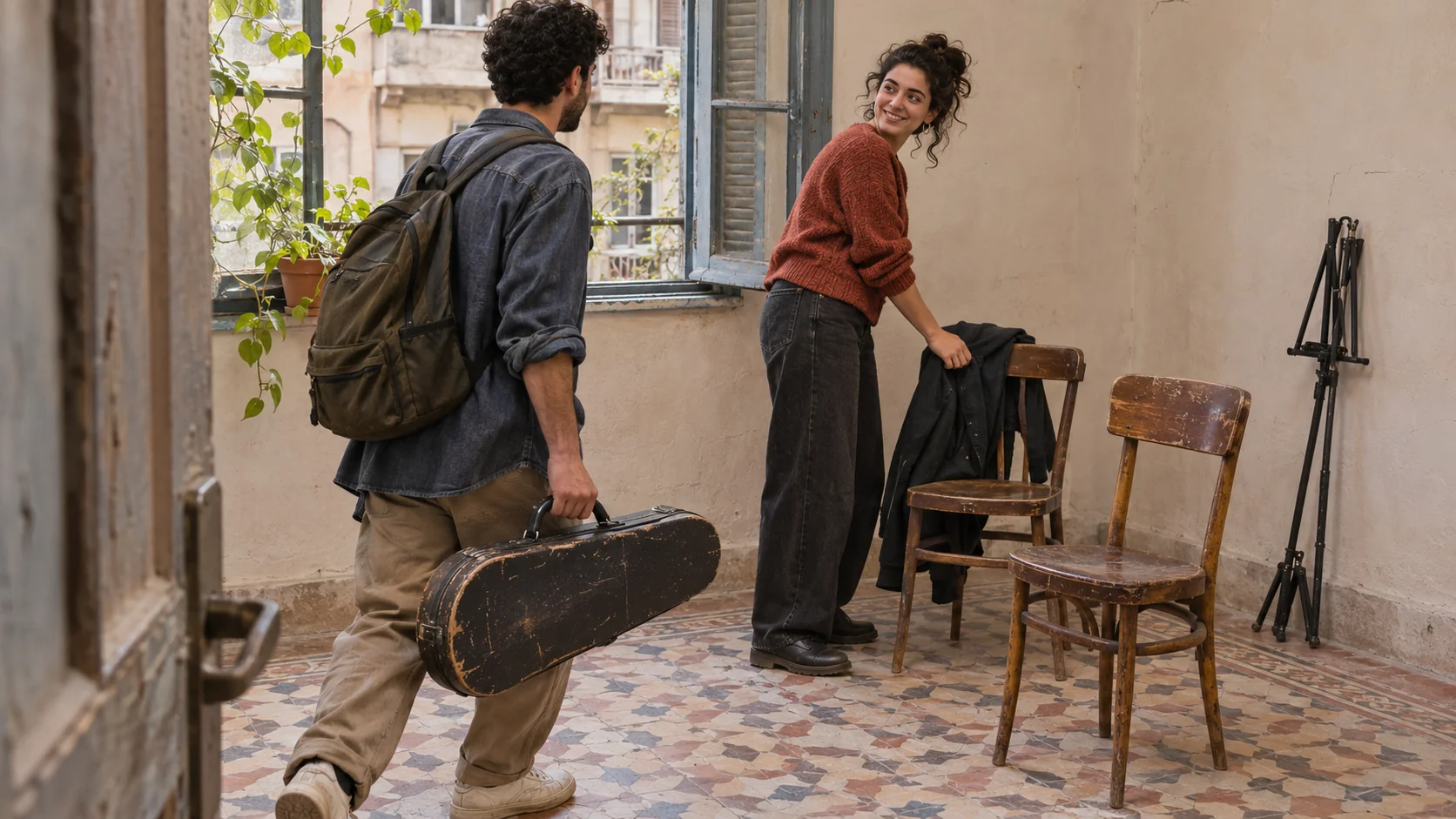
From yesterday to every week
“He opened the rehearsal room early yesterday” gives you فتح (fataḥ). “He opens the rehearsal room early every week” gives you بيفتح (byiftaḥ). In these scenes, the simple past reports a completed event and the indicative present describes a routine.
Listen to what changes between fataḥ and byiftaḥ. The present form begins with by-, and the first vowel of fataḥ drops out. With katab and byiktub, the last vowel changes too. Learn each verb as a pair so you can recall the present stem when the time cue changes. Lebanese Arabic Institute, Book 2 lesson outline
Keep the time cue and change the person
Start with byiktub, “he writes.” If she takes over the same weekly job, it’s بتكتب (btiktub). If we do it, it’s منكتب (mniktub). Keep -iktub and change the start of the word. Now move “we” to yesterday. You need كتبنا (katabna), with -na at the end. Yallah Speak’s Beirut conjugation table, which writes the short vowels differently
“Come” needs its own pair. جيت (jīt) is “I came,” and بجي (biji) is “I come.” For “he came,” use إجا (ija). Here j sounds like the s in “measure,” sh as in “ship,” and ḥ is the deeper throat sound written ح. A bar over a vowel, as in jīt, marks a long vowel. Lingualism’s pronunciation guide and Table 1
Ten scenes to try aloud
Before you check the answers, say or write just the bold verb. If you get stuck, find the subject and the time cue first. Leave a blank if you’re still unsure and fill it in when you check.
- He writes the number of borrowed stands on the board after every rehearsal.
- She drank her coffee on the bus this morning.
- I came straight here with my violin case after work yesterday.
- He opens the high windows before every rehearsal.
- We wrote the names of the new musicians on the back of the program last night.
- He ate his lunch on the steps yesterday.
- She writes a note on the score whenever we change the ending.
- I come here every Tuesday to rehearse.
- We write down the pieces we want to try at the start of each rehearsal.
- They came in just as we were packing up last night.
Answers and what to listen for
- بيكتب (byiktub). “After every rehearsal” makes it a routine. For “he writes,” listen for by- and the u in the last syllable.
- شربت (shirbit). She finished her coffee earlier. Compare shirib, “he drank,” with shirbit, “she drank.” The vowel after r drops out and the form ends in -it.
- جيت (jīt). “I” came once, yesterday. Keep the long ī.
- بيفتح (byiftaḥ). He does it before every rehearsal. Say byiftaḥ next to fataḥ, “he opened,” to hear the change.
- كتبنا (katabna). “We” and “last night” give you the past form ending in -na.
- أكل (akal). He finished his lunch yesterday. Compare byēkul, “he eats.” The vowel change inside the present form gives you another pair to learn.
- بتكتب (btiktub). “Whenever” tells you it’s a habit. Use the same -iktub as in scene 1 and start with bt- for “she.”
- بجي (biji). “Every Tuesday” makes it a routine. Put it alongside scene 3 and say jīt for yesterday, then biji for every Tuesday.
- منكتب (mniktub). “Each rehearsal” keeps it in the present. Compare mn- here with -na in scene 5. Both verbs have “we” as the subject.
- إجوا (iju). A group came once last night. Compare the final u in iju with the a in ija, “he came.”
The food and drink forms follow Lingualism’s Lebanese vocabulary and verb materials. Food and drink vocabulary · “Drink” conjugation with audio
Try the two forms you mixed up tomorrow
Pick two answers that gave you trouble and read a few other scenes before you try them again. Space out the next attempts over several days. Having to produce the verb after a gap helps it stick. If you turn a scene into a flashcard, keep the subject and the time cue on the front and put the Arabic form and its pronunciation on the back. Research on spaced recall · How to use flashcards for language learning
For more prompts with the same English-to-Lebanese recall format, the Everyday Spoken Levantine Arabic Verbs deck has 31 cards with Arabic script and pronunciation on the answer side.
The original practice scenes were drafted with AI assistance. The linked Lebanese Arabic teaching materials are the references for the forms.