Force–Displacement Graph Flashcards
Practice reading signed work from force–position graphs. Use net work to find speed or check whether a particle reaches a position.
Σχετικά με αυτήν τη δέσμη
Start with rectangles and triangles on one-dimensional force–position graphs. The cards show how the direction of travel affects the sign of work and how to add areas on opposite sides of the zero-force line. Three original graphs give you practice reading coordinates and splitting up the area yourself.
Then use net work to find changes in kinetic energy, calculate speed, and check whether a cart reaches a position or hits a turning point first. The later cards ask you to track the work along the way, since the energy calculated at the endpoint alone can miss an earlier stop.
These cards assume you know rectangle and triangle area. They omit graph reconstruction from total work, since many force profiles can do the same work. The questions, answers, and diagrams were created independently for introductory mechanics practice.
Κάρτες σε αυτήν τη δέσμη
Κάρτα 1
Ερώτηση
On a force–position graph, what does a negative value of the force component Fₓ mean?
Απάντηση
The force component points in the negative x direction at that position.
Κάρτα 2
Ερώτηση
A cart moves right. How do you get the work done by a force from its force–position graph?
Απάντηση
Add the areas above the zero-force line and subtract the areas below it between the start and end positions. The graph must show the force component along x.
Κάρτα 3
Ερώτηση
What is the unit of area on a force–position graph with force in newtons and position in meters?
Απάντηση
Joules. One newton-meter of work equals one joule.
Κάρτα 4
Ερώτηση
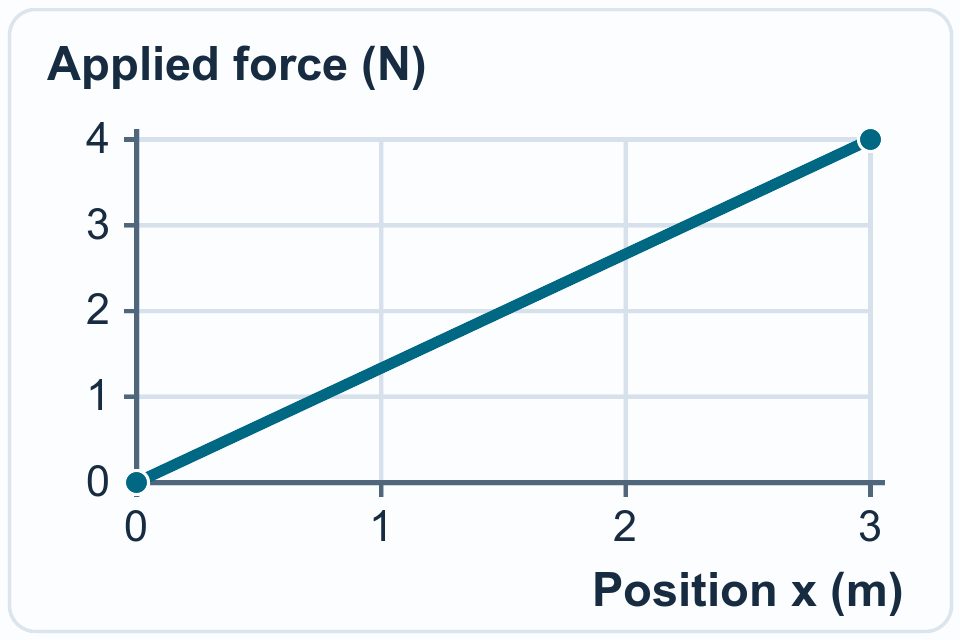
A cart moves right from x = 0 m to x = 3 m. How much work does the applied force shown on this force–position graph do?
Απάντηση
+6 J. The triangle above zero has area ½ × 3 m × 4 N.
Κάρτα 5
Ερώτηση
A force–position graph is flat at +2 N from x = 1 m to x = 6 m. How much work does that force do as a cart moves right across the interval?
Απάντηση
+10 J. The rectangle has height 2 N and width 5 m.
Κάρτα 6
Ερώτηση
A cart moves left through a region where the x-component of a force stays negative. What is the sign of the work done by that force?
Απάντηση
Positive. The force and the displacement both point left.
Κάρτα 7
Ερώτηση
A graph shows only the magnitude of a force along the x-axis versus position. Can you use it to tell the sign of that force’s work on a cart moving right?
Απάντηση
No. You also need the direction of the force along the path.
Κάρτα 8
Ερώτηση
A force rises linearly from +1 N at x = 1 m to +5 N at x = 4 m. How much work does it do as a cart moves right between those points?
Απάντηση
+9 J. The trapezoid has width 3 m and average height (1 N + 5 N) ÷ 2 = 3 N.
Κάρτα 9
Ερώτηση
A force–position graph reads −4 N from x = 2 m to x = 5 m. How much work does that force do on a cart that moves right through the interval?
Απάντηση
−12 J. The constant force is −4 N and the displacement is +3 m.
Κάρτα 10
Ερώτηση
A cart moves right through two regions of a force–position graph. One region has an area of 8 J above zero and the other has an area of 8 J below zero. How much work does the plotted force do in total?
Απάντηση
0 J. The signed contributions are +8 J and −8 J.
Κάρτα 11
Ερώτηση
A +3 N horizontal force acts as a cart moves left from x = 5 m to x = 2 m. How much work does this force do?
Απάντηση
−9 J. The force is +3 N and the displacement is −3 m.
Κάρτα 12
Ερώτηση
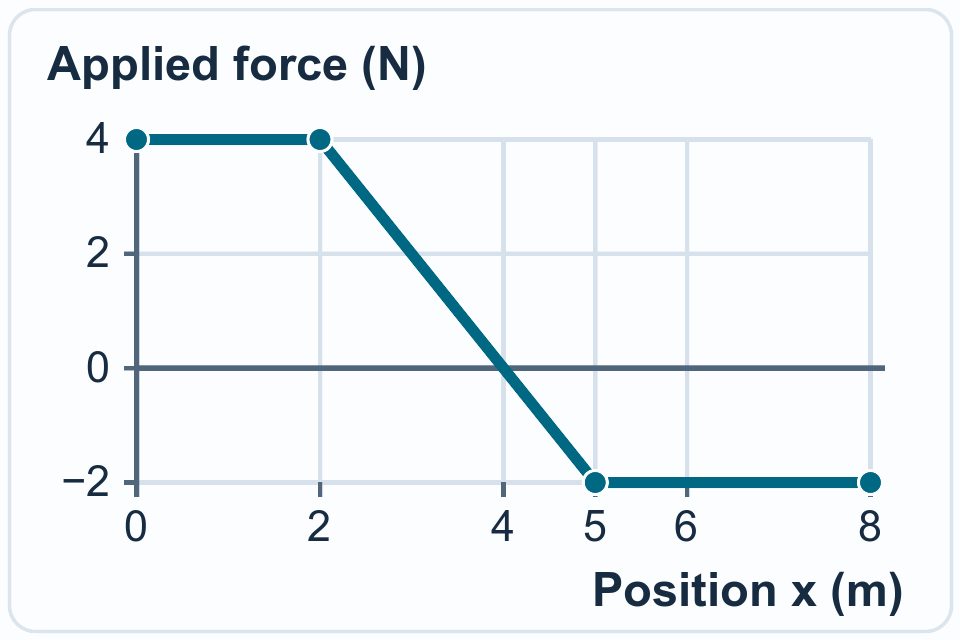
A cart moves right from x = 0 m to x = 8 m. How much work does the applied force shown on this force–position graph do?
Απάντηση
+5 J. The sloping segment crosses zero at x = 4 m. From left to right, the signed areas are +8 J, +4 J, −1 J, and −6 J.
Κάρτα 13
Ερώτηση
What does the signed area on a graph of the x-component of force versus time give you?
Απάντηση
The x-component of the impulse from that force, in newton-seconds.
Κάρτα 14
Ερώτηση
A cart travels from x = 1 m to x = 4 m and back. A force along x depends only on position. How much work does that force do over the whole trip?
Απάντηση
0 J. The return leg has the opposite signed work because the cart retraces the same positions under the same force.
Κάρτα 15
Ερώτηση
What change does the net work on a cart equal?
Απάντηση
The change in its kinetic energy, from the start of the interval to the end.
Κάρτα 16
Ερώτηση
A motor does +14 J of work on a cart and drag does −9 J. No other force does work. What is the net work on the cart?
Απάντηση
+5 J. Add the work done by both forces.
Κάρτα 17
Ερώτηση
A cart starts with 14 J of kinetic energy. The net work on it is −5 J. What is its final kinetic energy?
Απάντηση
9 J. Add the signed net work to the initial kinetic energy.
Κάρτα 18
Ερώτηση
What is the kinetic energy of a 2 kg cart moving at 4 m/s?
Απάντηση
16 J. K = ½mv² = ½ × 2 kg × (4 m/s)².
Κάρτα 19
Ερώτηση
A 2 kg cart starts at 5 m/s. The net work on it is −16 J. What is its final speed?
Απάντηση
3 m/s. Its initial kinetic energy is 25 J and its final kinetic energy is 9 J. The speed is √(2 × 9 J ÷ 2 kg).
Κάρτα 20
Ερώτηση
A cart starts at x = 0 m and moves right. Which interval of its net force–position graph gives the work needed to find its kinetic energy at x = 4 m?
Απάντηση
From x = 0 m to x = 4 m. Add the signed area over the full interval to the cart’s initial kinetic energy.
Κάρτα 21
Ερώτηση
A cart’s velocity changes from +4 m/s to −4 m/s. What is the net work on it over that interval?
Απάντηση
0 J. Its speed is 4 m/s at both endpoints, so its kinetic energy is the same.
Κάρτα 22
Ερώτηση
Using a net force–position graph and a cart’s starting energy gives K = −3 J at x = 6 m. What does this imply about reaching that position under the graph’s forces?
Απάντηση
The cart cannot reach x = 6 m from those starting conditions. Kinetic energy cannot fall below zero.
Κάρτα 23
Ερώτηση
A cart moving right passes x = 3 m. The net force points right just before x = 3 m and left just after it. Where is the cart fastest in that neighborhood?
Απάντηση
At x = 3 m. It gains kinetic energy just before that point and loses it just after.
Κάρτα 24
Ερώτηση
An applied force does +10 J of work on a sled while friction also acts. Is that enough information to tell whether the sled speeds up?
Απάντηση
No. The change in speed depends on the net work, which includes the work done by friction.
Κάρτα 25
Ερώτηση
A block enters a stretch with zero net force at 3 m/s. What is its speed while crossing that stretch?
Απάντηση
3 m/s. Zero net force means its velocity stays constant.
Κάρτα 26
Ερώτηση
A cart moves right through x = 2 m with 9 J of kinetic energy. The net force is −3 N from there to x = 7 m. Where does the cart first stop after passing x = 2 m?
Απάντηση
At x = 5 m. After 3 m at −3 N, the net work is −9 J and the kinetic energy falls to zero.
Κάρτα 27
Ερώτηση
A puck starts moving right from x = 0 m with 4 J of kinetic energy. Its net force depends only on position. The signed area is −7 J from 0 to 2 m and +6 J from 2 to 5 m. Can it reach x = 5 m?
Απάντηση
No. Reaching x = 2 m would require a kinetic energy of 4 J − 7 J = −3 J, so the puck cannot enter the region that would add 6 J.
Κάρτα 28
Ερώτηση
A cart moves left from x = 5 m to x = 2 m with a constant net force of −2 N. It starts with 8 J of kinetic energy. What is its kinetic energy at x = 2 m?
Απάντηση
14 J. The net force and displacement are both negative, so the work is (−2 N) × (−3 m) = +6 J.
Κάρτα 29
Ερώτηση
Two carts with the same mass and starting speed travel between the same two positions. Their net force–position graphs have different shapes but give the same signed work for the trip. How do their final speeds compare?
Απάντηση
The final speeds are equal. Equal net work gives the same change in kinetic energy, and both carts started with the same kinetic energy.
Κάρτα 30
Ερώτηση
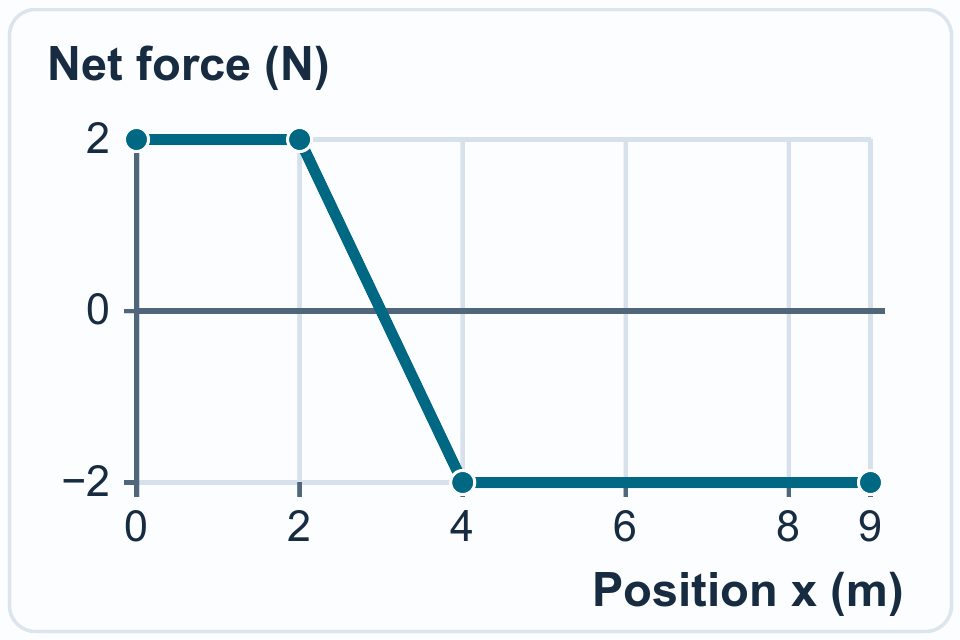
A puck starts moving right at x = 0 m with 4 J of kinetic energy. Use the net force–position graph to find where it first stops.
Απάντηση
At x = 8 m. It gains 4 J over the first 2 m. The positive and negative areas from 2 to 4 m cancel, so it has 8 J at x = 4 m. The −2 N force removes those 8 J over the next 4 m, then makes the puck turn back.

30 κάρτες
Force–Displacement Graph Flashcards
Το Nibomo ανοίγει για να ξεκινήσετε τη μελέτη.


