Force–Displacement Graph Flashcards
Practice reading signed work from force–position graphs. Use net work to find speed or check whether a particle reaches a position.
Despre acest pachet
Start with rectangles and triangles on one-dimensional force–position graphs. The cards show how the direction of travel affects the sign of work and how to add areas on opposite sides of the zero-force line. Three original graphs give you practice reading coordinates and splitting up the area yourself.
Then use net work to find changes in kinetic energy, calculate speed, and check whether a cart reaches a position or hits a turning point first. The later cards ask you to track the work along the way, since the energy calculated at the endpoint alone can miss an earlier stop.
These cards assume you know rectangle and triangle area. They omit graph reconstruction from total work, since many force profiles can do the same work. The questions, answers, and diagrams were created independently for introductory mechanics practice.
Fișele din acest pachet
Fișa 1
Întrebare
On a force–position graph, what does a negative value of the force component Fₓ mean?
Răspuns
The force component points in the negative x direction at that position.
Fișa 2
Întrebare
A cart moves right. How do you get the work done by a force from its force–position graph?
Răspuns
Add the areas above the zero-force line and subtract the areas below it between the start and end positions. The graph must show the force component along x.
Fișa 3
Întrebare
What is the unit of area on a force–position graph with force in newtons and position in meters?
Răspuns
Joules. One newton-meter of work equals one joule.
Fișa 4
Întrebare
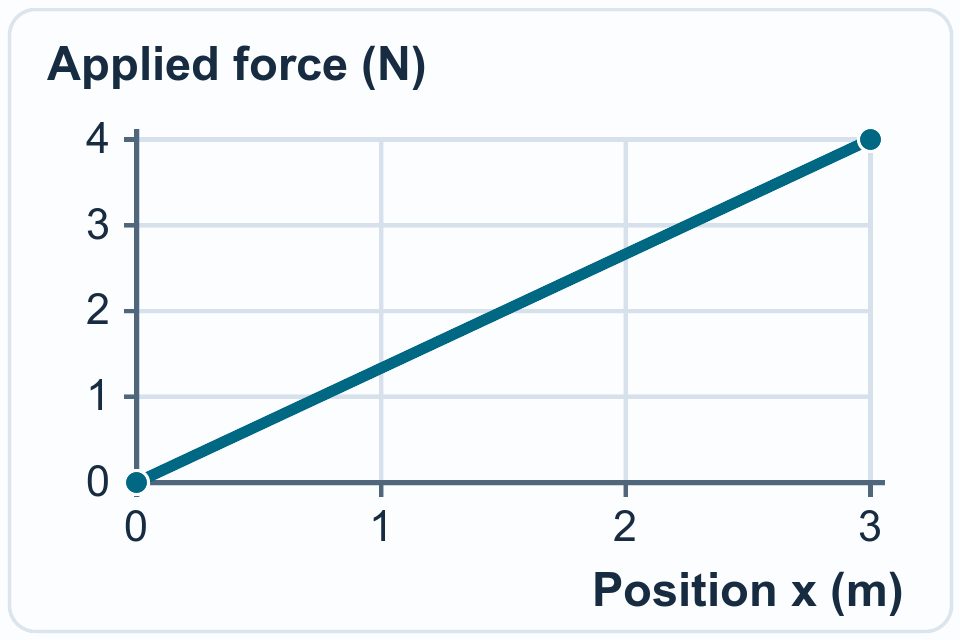
A cart moves right from x = 0 m to x = 3 m. How much work does the applied force shown on this force–position graph do?
Răspuns
+6 J. The triangle above zero has area ½ × 3 m × 4 N.
Fișa 5
Întrebare
A force–position graph is flat at +2 N from x = 1 m to x = 6 m. How much work does that force do as a cart moves right across the interval?
Răspuns
+10 J. The rectangle has height 2 N and width 5 m.
Fișa 6
Întrebare
A cart moves left through a region where the x-component of a force stays negative. What is the sign of the work done by that force?
Răspuns
Positive. The force and the displacement both point left.
Fișa 7
Întrebare
A graph shows only the magnitude of a force along the x-axis versus position. Can you use it to tell the sign of that force’s work on a cart moving right?
Răspuns
No. You also need the direction of the force along the path.
Fișa 8
Întrebare
A force rises linearly from +1 N at x = 1 m to +5 N at x = 4 m. How much work does it do as a cart moves right between those points?
Răspuns
+9 J. The trapezoid has width 3 m and average height (1 N + 5 N) ÷ 2 = 3 N.
Fișa 9
Întrebare
A force–position graph reads −4 N from x = 2 m to x = 5 m. How much work does that force do on a cart that moves right through the interval?
Răspuns
−12 J. The constant force is −4 N and the displacement is +3 m.
Fișa 10
Întrebare
A cart moves right through two regions of a force–position graph. One region has an area of 8 J above zero and the other has an area of 8 J below zero. How much work does the plotted force do in total?
Răspuns
0 J. The signed contributions are +8 J and −8 J.
Fișa 11
Întrebare
A +3 N horizontal force acts as a cart moves left from x = 5 m to x = 2 m. How much work does this force do?
Răspuns
−9 J. The force is +3 N and the displacement is −3 m.
Fișa 12
Întrebare
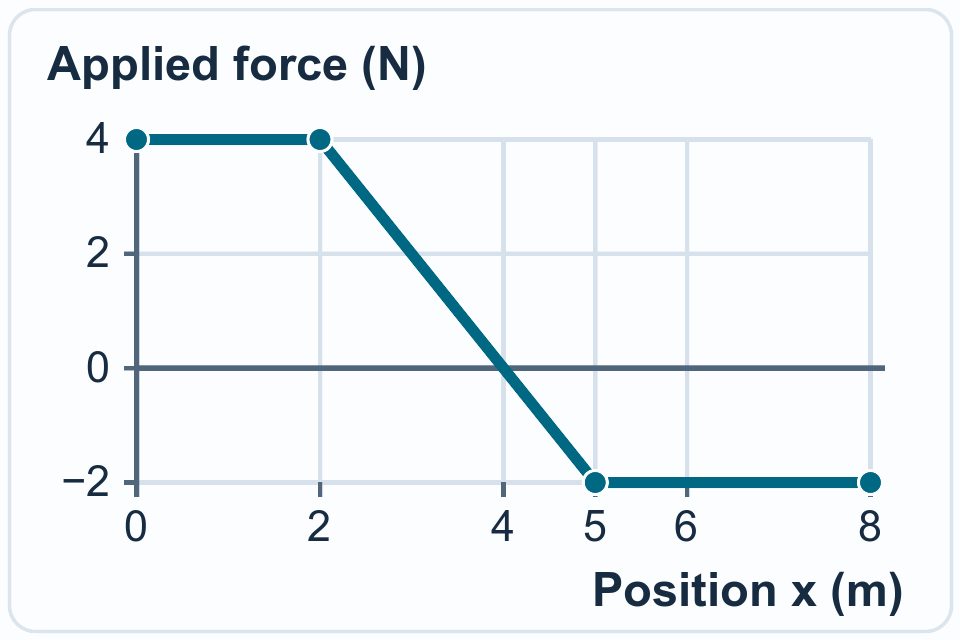
A cart moves right from x = 0 m to x = 8 m. How much work does the applied force shown on this force–position graph do?
Răspuns
+5 J. The sloping segment crosses zero at x = 4 m. From left to right, the signed areas are +8 J, +4 J, −1 J, and −6 J.
Fișa 13
Întrebare
What does the signed area on a graph of the x-component of force versus time give you?
Răspuns
The x-component of the impulse from that force, in newton-seconds.
Fișa 14
Întrebare
A cart travels from x = 1 m to x = 4 m and back. A force along x depends only on position. How much work does that force do over the whole trip?
Răspuns
0 J. The return leg has the opposite signed work because the cart retraces the same positions under the same force.
Fișa 15
Întrebare
What change does the net work on a cart equal?
Răspuns
The change in its kinetic energy, from the start of the interval to the end.
Fișa 16
Întrebare
A motor does +14 J of work on a cart and drag does −9 J. No other force does work. What is the net work on the cart?
Răspuns
+5 J. Add the work done by both forces.
Fișa 17
Întrebare
A cart starts with 14 J of kinetic energy. The net work on it is −5 J. What is its final kinetic energy?
Răspuns
9 J. Add the signed net work to the initial kinetic energy.
Fișa 18
Întrebare
What is the kinetic energy of a 2 kg cart moving at 4 m/s?
Răspuns
16 J. K = ½mv² = ½ × 2 kg × (4 m/s)².
Fișa 19
Întrebare
A 2 kg cart starts at 5 m/s. The net work on it is −16 J. What is its final speed?
Răspuns
3 m/s. Its initial kinetic energy is 25 J and its final kinetic energy is 9 J. The speed is √(2 × 9 J ÷ 2 kg).
Fișa 20
Întrebare
A cart starts at x = 0 m and moves right. Which interval of its net force–position graph gives the work needed to find its kinetic energy at x = 4 m?
Răspuns
From x = 0 m to x = 4 m. Add the signed area over the full interval to the cart’s initial kinetic energy.
Fișa 21
Întrebare
A cart’s velocity changes from +4 m/s to −4 m/s. What is the net work on it over that interval?
Răspuns
0 J. Its speed is 4 m/s at both endpoints, so its kinetic energy is the same.
Fișa 22
Întrebare
Using a net force–position graph and a cart’s starting energy gives K = −3 J at x = 6 m. What does this imply about reaching that position under the graph’s forces?
Răspuns
The cart cannot reach x = 6 m from those starting conditions. Kinetic energy cannot fall below zero.
Fișa 23
Întrebare
A cart moving right passes x = 3 m. The net force points right just before x = 3 m and left just after it. Where is the cart fastest in that neighborhood?
Răspuns
At x = 3 m. It gains kinetic energy just before that point and loses it just after.
Fișa 24
Întrebare
An applied force does +10 J of work on a sled while friction also acts. Is that enough information to tell whether the sled speeds up?
Răspuns
No. The change in speed depends on the net work, which includes the work done by friction.
Fișa 25
Întrebare
A block enters a stretch with zero net force at 3 m/s. What is its speed while crossing that stretch?
Răspuns
3 m/s. Zero net force means its velocity stays constant.
Fișa 26
Întrebare
A cart moves right through x = 2 m with 9 J of kinetic energy. The net force is −3 N from there to x = 7 m. Where does the cart first stop after passing x = 2 m?
Răspuns
At x = 5 m. After 3 m at −3 N, the net work is −9 J and the kinetic energy falls to zero.
Fișa 27
Întrebare
A puck starts moving right from x = 0 m with 4 J of kinetic energy. Its net force depends only on position. The signed area is −7 J from 0 to 2 m and +6 J from 2 to 5 m. Can it reach x = 5 m?
Răspuns
No. Reaching x = 2 m would require a kinetic energy of 4 J − 7 J = −3 J, so the puck cannot enter the region that would add 6 J.
Fișa 28
Întrebare
A cart moves left from x = 5 m to x = 2 m with a constant net force of −2 N. It starts with 8 J of kinetic energy. What is its kinetic energy at x = 2 m?
Răspuns
14 J. The net force and displacement are both negative, so the work is (−2 N) × (−3 m) = +6 J.
Fișa 29
Întrebare
Two carts with the same mass and starting speed travel between the same two positions. Their net force–position graphs have different shapes but give the same signed work for the trip. How do their final speeds compare?
Răspuns
The final speeds are equal. Equal net work gives the same change in kinetic energy, and both carts started with the same kinetic energy.
Fișa 30
Întrebare
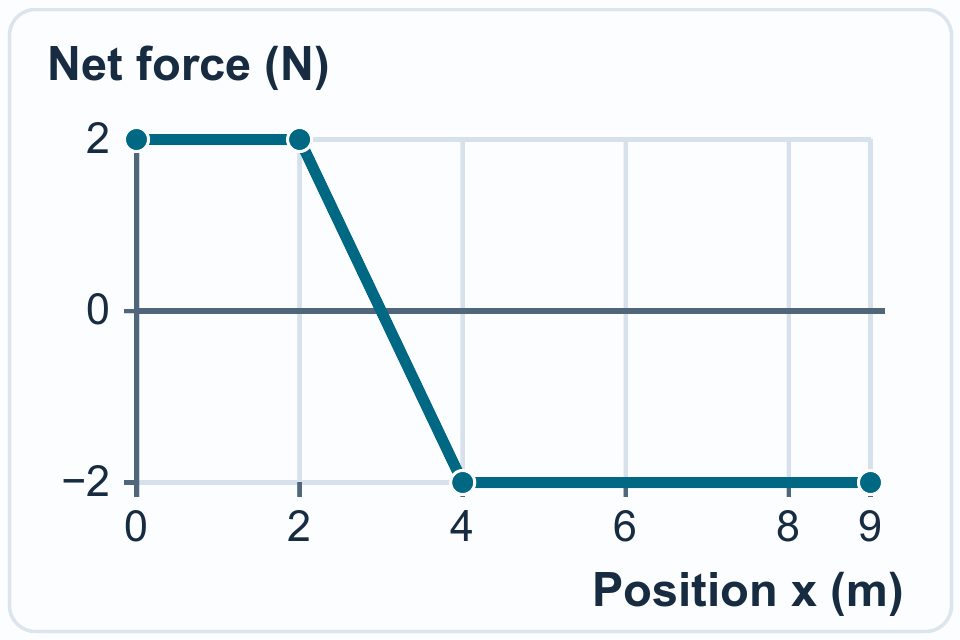
A puck starts moving right at x = 0 m with 4 J of kinetic energy. Use the net force–position graph to find where it first stops.
Răspuns
At x = 8 m. It gains 4 J over the first 2 m. The positive and negative areas from 2 to 4 m cancel, so it has 8 J at x = 4 m. The −2 N force removes those 8 J over the next 4 m, then makes the puck turn back.

30 de fișe
Force–Displacement Graph Flashcards
Nibomo se deschide ca să poți începe să studiezi.


